
.webp)



New Delhi, Nov 23: The Ministry of Home Affairs (MHA) has issued a cybersecurity advisory warning WhatsApp Web users about the possibility of unauthorised access to authenticated sessions, cautioning that malicious individuals could exploit such access to take control of accounts and misuse personal information.
The advisory, issued on November 18 by the National Cybercrime Threat Analytics Unit (NCTAU) of the Indian Cyber Crime Coordination Centre under the MHA, highlights the risks associated with leaving WhatsApp Web sessions active on office computers, shared systems and other devices accessible to third parties.
Titled 'Safe Use of WhatsApp Web', the advisory warns that an authenticated session could, under certain circumstances, be misused to access a user's WhatsApp account without authorisation.
Also read: SC mulls allowing only BS-VI vehicles in Delhi-NCR to combat air pollution
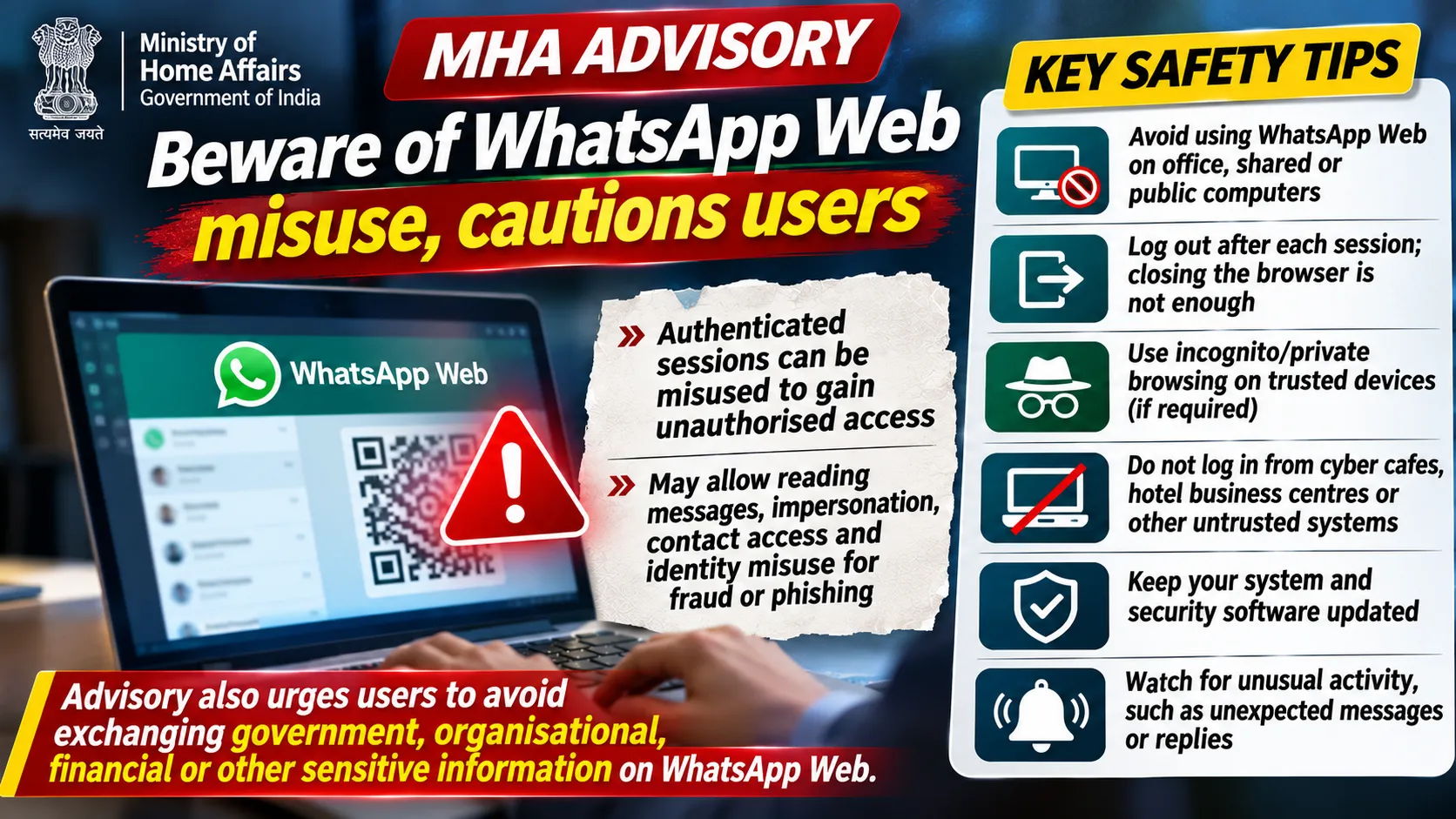
Such access could allow malicious actors to read private messages, send communications while impersonating the account holder, access contact lists and group conversations, and exploit the user's identity for financial fraud, phishing and social engineering attacks.
The MHA has advised users against exchanging government-related, organisational, financial, confidential or other sensitive information through WhatsApp Web sessions on computers.
It has also urged users not to leave authenticated sessions active when they are no longer required, particularly on office or shared devices.
The advisory specifically cautions that simply closing a browser window or tab does not log a user out of WhatsApp Web. Users should manually log out after completing each session to prevent others from accessing their accounts.
For temporary access, the advisory recommends using incognito or private browsing mode on a trusted computer, while ensuring that users manually log out before closing the browser.
It has also warned against accessing WhatsApp Web through cyber cafes, public kiosks, hotel business centres, borrowed computers and other untrusted systems. Users have been asked to remain alert to unusual account activity, including unexpected messages sent from their accounts, unexplained conversations and unusual responses from contacts.
The MHA has further recommended keeping operating systems, browsers and security software updated, while avoiding suspicious downloads, unknown files, cracked software and untrusted applications.
For organisations handling sensitive information, the advisory reiterates the need for caution when using WhatsApp Web on office computers and recommends additional safeguards, including private browsing. (With ANI inputs)
.webp)