
.webp)

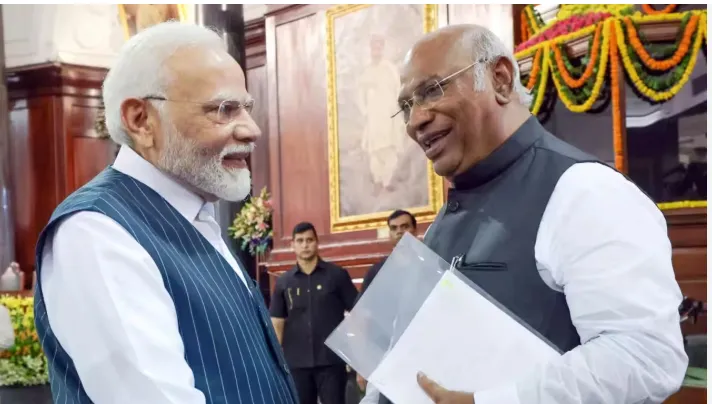
New Delhi, August 27:Congress president and Leader of Opposition in the Rajya Sabha Mallikarjun Kharge on Thursday urged Prime Minister Narendra Modi to convene an all-party meeting on the proposed delimitation exercise, saying political parties and state governments should be given sufficient time to examine the proposals.
In a letter to Modi, Kharge reiterated his earlier request of July 16, made after reports that Union Parliamentary Affairs Minister Kiren Rijiju had indicated that a special session of Parliament could be convened to discuss delimitation.
Kharge said the Congress had a clear position on the issue and called for the existing strength of the Lok Sabha to remain unchanged at 543 seats for another 25 years.
He also sought continuation of the current state-wise allocation of Lok Sabha seats for the same period. At the same time, Kharge demanded that one-third reservation for women be implemented from the 2029 Lok Sabha elections.
"Before you go ahead as indicated by the Union Minister of Parliamentary Affairs, I wish to reiterate my earlier request to you to convene an All-Party meeting to discuss whatever delimitation proposals you have in mind," Kharge said in the letter.
He further urged the Prime Minister to provide political parties and state governments adequate time to study the proposals before they are introduced in Parliament.
Describing delimitation as an issue of "enormous significance for the country", Kharge cautioned the government against proceeding without wider consultation. He alleged that the government should not "bulldoze" the proposals, referring to developments on April 16 and 17, 2026.
Delimitation involves redrawing parliamentary and assembly constituencies based on population. The proposed exercise has triggered a political debate, particularly over the potential impact on the representation of states that have successfully controlled population growth.
Southern states have expressed concerns that they could lose their relative share of parliamentary representation if seats are redistributed primarily on the basis of current population figures, while faster-growing northern states could gain additional representation.
Against this backdrop, opposition parties have been pressing for the existing number and state-wise distribution of Lok Sabha seats to remain unchanged for a fixed period, arguing that states should not be politically penalised for their population-control measures.
Kharge's latest letter seeks to make the proposed delimitation exercise subject to broader political consultation and a 25-year continuation of the existing Lok Sabha seat structure.
.webp)