


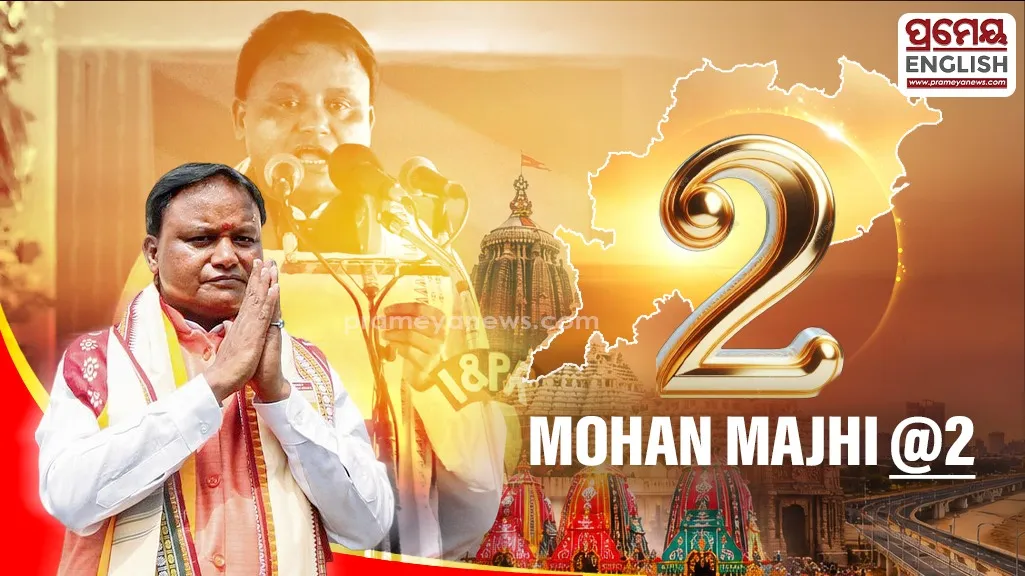
Bhubaneswar, June 11: As Chief Minister Mohan Charan Majhi completes two years in office on June 12, 2026, Odisha finds itself at an important political juncture. The Bharatiya Janata Party's historic victory in the 2024 Assembly elections ended the Biju Janata Dal's uninterrupted 24-year rule under Naveen Patnaik and ushered in a new era of governance in the state.
The mandate was not merely for a change of government but for a new style of governance, faster development and greater accountability. Two years later, as the BJP government completes its second anniversary, it has several achievements to showcase—from fulfilling major poll promises and attracting record investment proposals to curbing Maoist influence and expanding welfare programmes.
But as the honeymoon period fades, the administration faces tougher questions about jobs, healthcare, corruption perceptions and its ability to build a durable grassroots presence. The government's second anniversary offers an opportunity to assess both the gains made and the challenges ahead.
Delivering on key promises
The BJP government began its tenure with remarkable speed. Immediately after being sworn in on June 12, 2024, Chief Minister Mohan Charan Majhi and his cabinet moved to fulfil some of the party's most prominent election promises.
The reopening of all four gates of the Jagannath Temple in Puri on the very day the government assumed office was seen as a symbolic and politically significant move. This was followed by the opening of the Ratna Bhandar and the inventorisation of the temple's ornaments, fulfilling long-standing demands of devotees.
The first cabinet meeting approved the landmark Subhadra Yojana, a flagship welfare scheme aimed at empowering women. The government also enhanced input assistance for farmers and subsequently implemented several other promises, including the rollout of Ayushman Bharat in the state. Most of the BJP's headline pre-poll commitments have either been implemented or substantially advanced within the first two years.
Women, farmers and welfare initiatives
Among the government's most notable achievements has been the expansion of welfare programmes. The Subhadra Yojana has reached more than one crore women, strengthening the BJP's outreach among female voters. The government also claims to have helped create around 23.46 lakh "Lakhpati Didis", promoting women's economic empowerment and self-reliance.
Farmers have also remained a major focus area. More than 42 lakh farmers have reportedly benefited from a combination of state and central incentives, including enhanced input assistance and support measures-PM Kishan and CM Kishan-aimed at improving agricultural productivity and incomes.
The government further strengthened social security benefits by increasing pension assistance. However, this remains one of the areas where public expectations continue to exceed delivery. The BJP had promised a monthly pension of Rs 3,500 for senior citizens, but currently only those above 80 years receive that amount, while citizens between 60 and 80 years continue to receive Rs 1,000 per month.
Investment push and economic transformation
One of the defining features of the Majhi government's tenure has been its emphasis on investment-led growth and industrialisation.
The successful organisation of the Utkarsh Odisha Conclave attracted investment proposals worth nearly Rs 20 lakh crore, while projects worth more than Rs 3 lakh crore have already been grounded. The government has actively sought to position Odisha as an emerging investment destination by showcasing its industrial potential before domestic and international investors.
The hosting of Pravasi Bharatiya Divas further strengthened Odisha's visibility on the global stage and helped deepen engagement with the Indian diaspora.
Importantly, the government has attempted to diversify Odisha's industrial landscape beyond its traditional dependence on mining and mineral-based industries. Focus sectors now include electronics manufacturing, information technology, textiles and apparel, renewable energy, defence technology, port-based industries and services. The state's ambitious plans to emerge as a semiconductor manufacturing hub reflect a broader effort to align Odisha with future-oriented industries.
Infrastructure gets a boost
The BJP government has also benefited from strong support from the Centre under the "double-engine" model. Odisha received a record railway allocation of Rs 10,928 crore in 2026, along with substantial investments in national highway expansion and connectivity projects.
Several major infrastructure initiatives are in the pipeline, including the Bhubaneswar-Cuttack-Puri-Paradip Economic Zone, the Capital Ring Road project, coastal road, new ports and airports, and enhanced logistics infrastructure. These projects are expected to strengthen Odisha's economic competitiveness and attract further investment in the coming years.
Major success against Naxalism
Perhaps one of the most significant achievements claimed by the government is the near-complete elimination of Left-Wing Extremism from Odisha.
When the BJP assumed office in 2024, nine districts remained affected by Maoist activity. Two years later, all these districts have reportedly been freed from Naxalite influence through a combination of security operations, intelligence-driven interventions and surrender policies. Several Maoist leaders were neutralised in encounters while many cadres surrendered, marking a major milestone in Odisha's internal security landscape.
Public grievance redressal
Chief Minister Majhi has consistently sought to project an image of accessible and people-centric governance. The government's grievance redressal mechanism has remained active across districts, with the Chief Minister personally monitoring public complaints.
Official figures indicate that nearly 2.40 lakh grievances were heard across districts by April 2026, with a resolution rate of approximately 92 per cent. The Chief Minister's grievance cell reportedly received 14,651 complaints during the first 17 rounds of hearings and resolved 14,046 of them, translating into a success rate of around 96 per cent.
These initiatives have helped reinforce the government's image of responsiveness and accountability.
Emerging governance challenges
Despite these achievements, the government faces a number of challenges as it enters the second half of its term.
Law and order has emerged as a major concern in several regions. Reports of rising criminal activity have generated public anxiety, prompting the administration to adopt a tougher approach. Police have been directed to act firmly against criminal networks, and a series of encounters involving hardened offenders suggest that law enforcement agencies have been given greater operational autonomy.
Another challenge relates to corruption and public perception. The BJP came to power promising transparent governance and an end to alleged corruption under the previous regime. Consequently, allegations involving illegal sand mining and local-level irregularities against some BJP leaders have attracted attention.
Panchayat test
Politically, the BJP's biggest challenge lies in strengthening its grassroots organisational structure.
The party's 2024 Assembly election victory was aided significantly by anti-incumbency against the BJD. However, translating electoral success into durable grassroots dominance remains a work in progress.
With Panchayat elections approaching, the BJP will need to expand its rural cadre base, strengthen local leadership and convince voters through governance performance.
Healthcare, employment and agriculture
Healthcare continues to be another area requiring attention. Although the implementation of Ayushman Bharat was expected to improve healthcare access, many beneficiaries feel that the earlier Biju Swasthya Kalyan Yojana functioned more smoothly. The government's recent decision to include diagnostic and pathological tests under the scheme has been welcomed, but further improvements in service delivery may be necessary.
Employment generation remains a long-term challenge. Expanding irrigation networks, promoting agro-based industries, reviving cottage industries and encouraging entrepreneurship could help create sustainable local employment opportunities.
Agriculture presents a similar picture. While Odisha has recorded encouraging growth in paddy, millet, fruit and vegetable production, farmers continue to face persistent issues such as inadequate storage facilities, weak market linkages and poor price realisation. Addressing these structural constraints will be essential for raising farm incomes.
Looking ahead
At the completion of two years in office, the Mohan Majhi government can legitimately claim substantial progress in fulfilling electoral promises, attracting investments, improving infrastructure and strengthening internal security. The government has established a distinct governance identity while benefiting from strong cooperation with the Centre.
Yet the more difficult phase of governance begins now. Converting investment commitments into jobs, strengthening healthcare delivery, fulfilling pending welfare promises, improving law and order, tackling corruption perceptions and building a durable grassroots organisation will determine whether the BJP can consolidate its position in Odisha.