.webp)

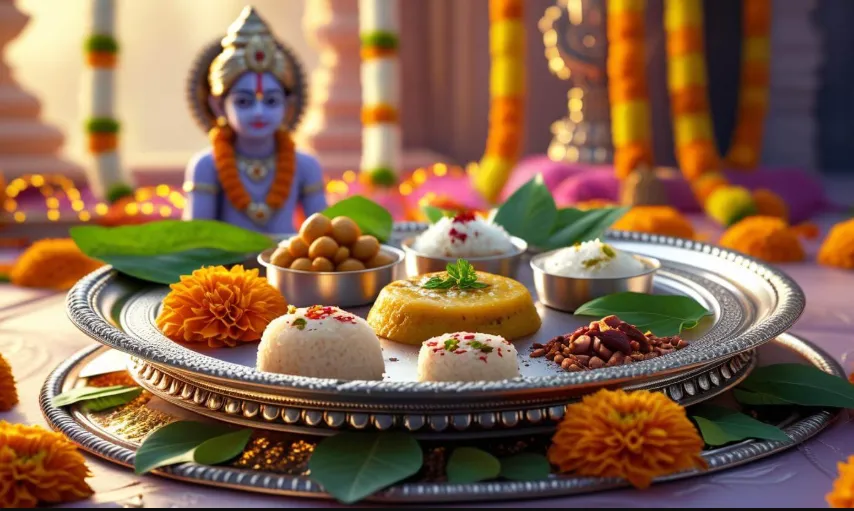
From makhan and mishri to pitha and creamy kheer, Janmashtami turns the humble foods associated with Krishna into a celebration of taste, tradition and childhood memories.
If Krishna were to walk into an Indian kitchen today, what would he reach for first?
Would it be a bowl of freshly churned makhan? A plate of pitha? Or perhaps a sweet serving of kheer waiting beside the puja altar?
There may be no single answer. Across India, Janmashtami bhog changes with geography, culture and family tradition. Yet one thing remains constant — food has always been closely woven into the stories of Krishna's childhood.
And perhaps no food is more closely associated with Kanha than makhan.
The little butter thief
The image is instantly familiar — a mischievous Krishna, surrounded by his friends, reaching for a pot of butter.
The stories of Krishna stealing butter from the homes of Gokul's residents have made makhan one of the most recognisable foods associated with him. For devotees, offering butter and mishri during Janmashtami is a way of remembering the playful Bal Gopal.
There is something wonderfully childlike about it. No elaborate feast, no complicated recipe — just soft butter, sweetness and the memory of a little boy who could apparently never resist it.
From butter to fried rice
Another food strongly connected with Krishna's stories is fried rice (Chaula bhaja), particularly through his friendship with Sudama.
The story of Sudama arriving to meet his childhood friend Krishna carrying a humble offering of beaten rice has given fried rice a special place in Krishna-related traditions.
The dish is simple, inexpensive and deeply comforting — a reminder that devotion is not measured by the price of an offering.
For many devotees, that is precisely the beauty of Krishna bhog: the simplest food can carry the deepest emotion.
Every region has its own Kanha
As Janmashtami travelled across India, local culinary traditions naturally found their way into celebrations.
In Odisha, traditional sweets and homemade delicacies can become part of festive offerings, with dishes such as chhena-based sweets, pitha and khiri reflecting the state's rich food culture.
In Maharashtra, Janmashtami celebrations are famously associated with dahi handi, bringing curd and yoghurt into the heart of the festivities.
In northern and western parts of India, milk, curd, butter, makhan, mishri and a variety of sweets are commonly associated with Krishna offerings.
And in Bengal, preparations made with milk, rice, fruits and sweets often find a place in Janmashtami observances.
The ingredients may change, but the idea remains beautifully similar: offer Kanha something made with love.
Why milk, curd and butter?
Krishna's childhood was spent in the pastoral world of Gokul and Vrindavan, surrounded by cows, cowherds and dairy products.
That cultural setting explains why milk, curd, butter and other dairy foods became so strongly associated with his childhood stories.
Over time, these foods became much more than ingredients. They became symbols of abundance, nourishment and affection — qualities devotees continue to associate with Bal Gopal.
And then comes the sweetness
No Indian festival feels complete without something sweet, and Janmashtami is no exception.
Khiri or kheer, peda, ladoo, mishri, fruits and other homemade sweets often appear in festive offerings, depending on regional and family traditions.
For mothers and grandmothers, preparing these dishes can itself become an act of devotion.
A pot of milk slowly simmering on the stove. Rice cooking gently. Cardamom filling the kitchen with fragrance. A plate of sweets being arranged carefully before the deity.
The food is prepared for Kanha — but it also brings the whole family together.
The bhog of childhood
Perhaps that is what makes Krishna's food traditions so special.
They are not only about what Krishna supposedly liked to eat. They are about how generations have imagined his childhood.
A child stealing butter.
A friend carrying a humble handful of poha.
A mother preparing something sweet for her little Kanha.
A family sitting together after the midnight celebration.
The elaborate festive spread may differ from one home to another, but somewhere underneath it is the same affection — the desire to feed, nurture and celebrate the beloved child.
So, what would Kanha eat?
If mythology gives us clues, makhan would probably be high on the list.
But if tradition has taught us anything, Kanha's plate has no fixed menu.
It can be butter and mishri in one home, poha in another, kheer somewhere else and a regional delicacy prepared specially by a grandmother in another.
Because perhaps Krishna's favourite food was never really about a particular dish.
It was about love.
And that may be the most delicious tradition Janmashtami has handed down through the generations.
.webp)