
.webp)


Bhubaneswar, December 31: Once a stubborn by-product of consumption, waste became an ever-growing challenge with rising populations and rapid urbanisation. Answering the call of Prime Minister Narendra Modi through the Swachh Bharat Mission, India flipped the script - under the Ministry of Housing Urban Affairs (MoHUA) leadership and SBM-U, waste is no longer a problem but a resource, transformed into products and revenue.
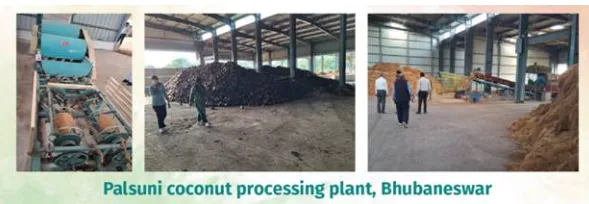
Bhubaneswar’s Palsuni coconut processing plant is turning sacred waste into wealth. It collects 5,000–6,000 coconuts daily from 189 vendors - once discarded temple remnants that clogged drains—and transforms them into 7,500+ kg of coir fiber and ropes, plus 48 metric tonnes of cocopeat-based compost and blocks for farming and gardening. With a 10,000-coconut daily capacity, the plant generates Rs 7–9 lakh monthly, while SHG members and Safaimitras gain steady income and dignity through technical training and employment.
From temple towns to tech hubs, India’s coconut waste journey under Swachh Bharat Mission–Urban proves that sustainability thrives when policy, people, and innovation align.
Coconut waste has transformed from mere “green waste” into a high-value resource. Official data shows coconut husk forms 3–5% of urban wet waste—small on paper, but massive when stacked against the 1.6 lakh tonnes of municipal waste generated daily, rising to 6–8% in coastal cities.
Setting the benchmark, Mysuru and Madurai have achieved 100% recycling of coconut waste, while religious centres such as Puri in Odisha, Varanasi in Uttar Pradesh and Tirupati in Andhra Pradesh have established specialised Material Recovery Facilities to process temple-generated coconut waste—ensuring that no shell is left behind.
Nowhere is this shift more evident than in coastal cities, where coconut waste -once a civic headache - has found a second life in the circular economy, turning nature’s leftovers into livelihoods and value.
.webp)