


.webp)


Securities trading rules transformed global commerce on May 17
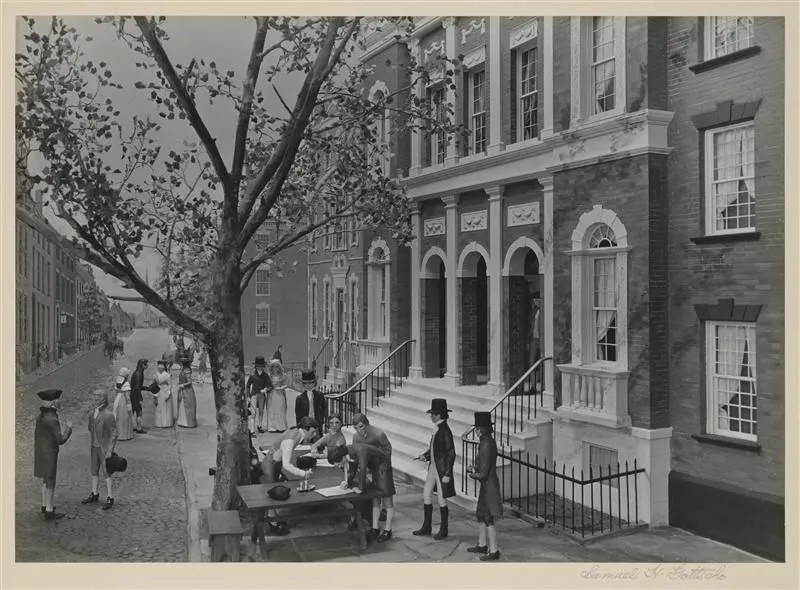
Twenty-four Wall Street brokers established the modern framework of international commerce on May 17, 1792, by signing a brief, eighty-two-word pact that birthed the New York Stock Exchange. Frustrated by chaotic public auctions and a debilitating financial panic earlier that spring, these elite merchants united to stabilize the young nation's volatile capital markets. The document, executed outside 68 Wall Street, forever altered how corporate and government wealth transfers operate across the globe.
Seeking Market Stability
Before this formal consensus, investments across the United States lacked uniform rules or protective oversight. The federal government, under Treasury Secretary Alexander Hamilton, had recently floated eighty million dollars in bonds to restructure Revolutionary War debts, attracting widespread speculation. Unscrupulous auctioneers frequently manipulated asset values, prompting the brokers to gather privately at Corre's Hotel to design a self-regulating marketplace.
The resulting pact introduced two mandatory directives that sidelined outside agents. First, the signatories promised to execute trades exclusively among themselves, cultivating a closed circle of reliable counterparties. Second, they mandated a fixed 0.25 percent securities commission, ensuring price uniformity for every transaction.
From Shade to Structure
Local folklore claims the initial signatures were gathered under a prominent American sycamore tree outside the trading offices. Historical records clarify that while transactions occurred outdoors during pleasant weather, the growing faction moved operations indoors within a year to the newly constructed Tontine Coffee House at Wall and Water streets. This shift from an informal club to a structured venue provided the foundation for the formalized New York Stock and Exchange Board established in 1817.
This institutional development mirrors early trading evolutions globally, much like how merchant guilds in Europe or regional trade syndicates during the British colonial era established localized hubs to secure capital flow. The principles of mutual preference and fixed transaction fees devised in lower Manhattan created an economic engine that outlasted the physical tree itself, which collapsed during an 1865 summer storm. Today, the single-page document remains securely preserved within corporate archival vaults as the structural blueprint for modern investment banking.
.webp)