

.webp)
Devshayani Ekadashi celebrations require authentic Odia Chuda Ghasa offerings
Devotees across Odisha prepare authentic Chuda Ghasa as a sacred offering to Lord Vishnu during the observance of Devshayani Ekadashi. This auspicious religious event marks the beginning of Chaturmas, a deeply spiritual four-month period where specific traditional temple recipes hold immense cultural weight. Preparing this specific delicacy demands both deep devotion and precise culinary technique to achieve the desired results.
Essential Ingredients for Preparation
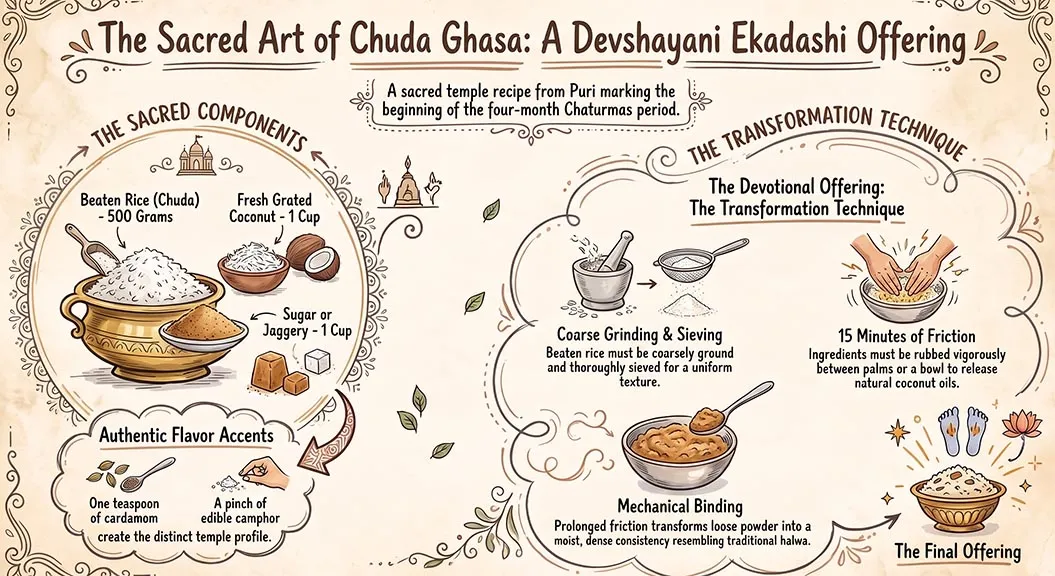
Creating the perfect Chuda Ghasa requires exactly half a kilogram of high-quality beaten rice, one cup of freshly grated coconut, and one cup of either sugar or jaggery. Cooks will also need half a cup of pure ghee, one teaspoon of fragrant green cardamom powder, and a tiny pinch of edible camphor to achieve the authentic temple flavor profile. This distinct combination of rich ingredients originates directly from the revered culinary traditions of the Puri district.
Processing Techniques
Crafting this divine offering begins with pounding the raw chuda coarsely using a conventional grinder or a traditional hema dasta. Cooks must follow this step with very thorough sieving to ensure uniform texture. Chefs then transfer this refined powder into a traditional, finely woven bamboo plate, which locals call a tato or kula. They carefully combine the freshly grated coconut and sweet sugar powder directly with the beaten rice.
Friction and Binding Process
Success relies entirely on a rigorous physical mixing technique. You must rub the ingredients vigorously using both palms, or the back of a heavy bowl, for at least fifteen minutes. This prolonged mechanical friction naturally releases rich lipid oils from the coconut flakes. These natural fats then organically bind with the dry rice starches, physically transforming the loose powder into a moist, dense consistency closely resembling traditional halwa. Finally, cooks incorporate the pure ghee, aromatic cardamom spices, and crushed camphor to complete the sacred dish.

With Inputs from: Ritu Pattanaik
.webp)