


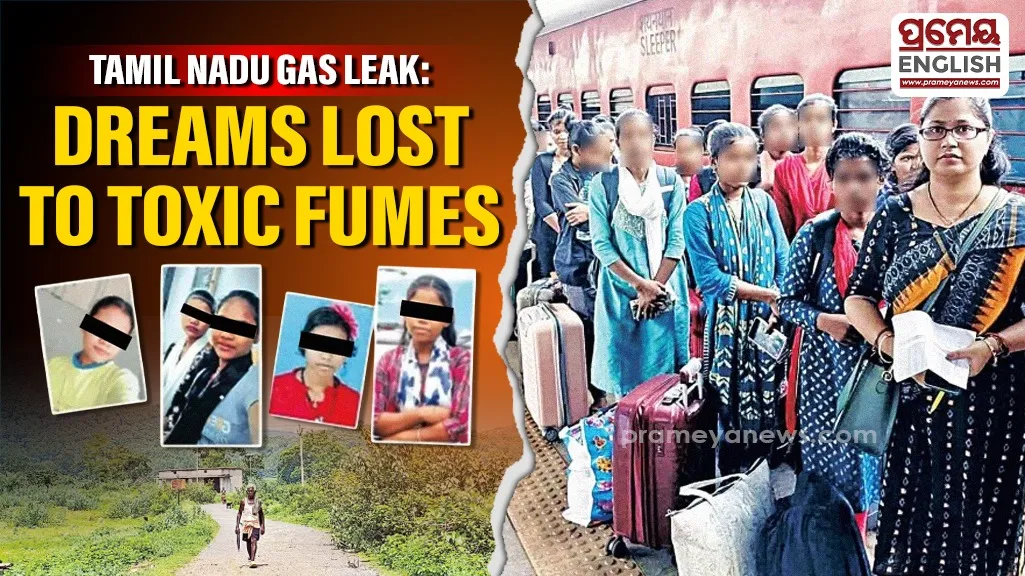
Keonjhar, June 30: The journey that began with hope for a better livelihood ended in silence for dozens of families in Odisha's Keonjhar district. The recent gas leak tragedy in Tamil Nadu, which claimed 13 lives, has left behind not just statistics but shattered homes, grieving parents and unanswered questions about migrant workers forced to leave their villages in search of survival.
For many families in Banspal, Telkoi, Harichandanpur and Ghatagaon blocks, the young men and women who travelled hundreds of kilometres to work in a seafood processing factory were not just wage earners—they were the pillars of their households. Their earnings kept kitchen fires burning and younger siblings in school. Today, their bodies have returned home, but the dreams they carried have not.
Among the bereaved is Janha Juang, a widowed mother from Kodipasa village in Banspal block. Her daughter, Sujani Juang, was the family's only earning member. With Sujani gone, Janha says darkness has descended on their home.
According to her, government officials accompanied the body home but never returned. Compensation remains a distant promise, while even basic assistance for funeral expenses was unavailable. The family had to rely on neighbours to perform the last rites. Some local leaders from the ruling party provided ration supplies, but for Janha, that is little comfort when the family's only source of income has disappeared forever.
Her story echoes across several villages where parents, many elderly and impoverished, are struggling to imagine life after losing their children.
The tragedy has also exposed the fragile reality of migrant labour from Keonjhar. Around 66 workers have returned after the factory shut down following the gas leak. They now face unemployment with little certainty about what comes next. Residents fear that once memories of the tragedy fade, labour contractors may once again lure desperate workers back to distant factories with promises of employment.
The incident has also raised uncomfortable questions about the administration's preparedness. Despite thousands of workers migrating annually from Keonjhar to states like Tamil Nadu through labour contractors, authorities reportedly do not have accurate records of how many workers leave the district. This lack of data has complicated monitoring, protection and emergency response.
Following the accident, the Odisha government announced an ex gratia of Rs 10 lakh for the families of the deceased, while the Tamil Nadu government announced Rs 2 lakh each. Yet, beyond compensation, families are asking whether enough was done to prevent such a tragedy in the first place.
Ironically, workers who travelled to Tamil Nadu reportedly earned about Rs 500 for 12 hours of work, while similar wages are available under state employment schemes for an eight-hour workday.
Activists argue that better awareness, local employment opportunities and stronger enforcement against illegal labour recruitment could have prevented many from leaving home under risky conditions.
The tragedy has once again highlighted the vulnerability of the Juang, one of Odisha's Particularly Vulnerable Tribal Groups (PVTGs). For decades, young Juang workers have migrated seasonally to Tamil Nadu in search of work. This is not the first warning. In 2017, the district administration rescued nine child labourers from Tamil Nadu. Yet migration has continued, suggesting that systemic problems remain unresolved.
Questions are also being raised about the effectiveness of the Juang Development Agency (JDA), established in 1978 at Gonasika to improve the socio-economic conditions of the tribal community. The agency once received nearly Rs 2 crore annually for development programmes across six gram panchayats in Banspal block. However, state funding reportedly stopped in March 2023. Nearly five decades after its formation, many Juang families still struggle with poverty, limited education and a lack of sustainable livelihoods, forcing the younger generation to seek low-paid jobs outside the state.
For the families mourning today, these policy debates offer little solace.