


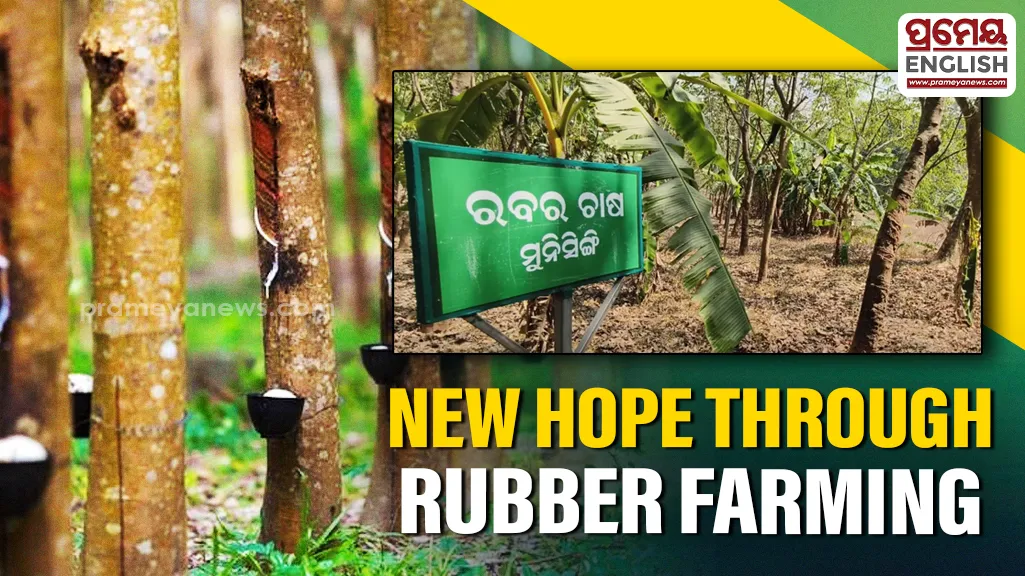
Gajapati, June 23: What was once a village dependent on migration and daily wage labour has now emerged as a model of self-reliance. More than 100 families in Munising village under Gumma block of Odisha’s Gajapati district have transformed their lives through rubber cultivation, earning a stable income and strengthening their economic condition.
Located in the tribal-dominated region of Gajapati, Munising village had long struggled with poverty. Residents used to migrate to other states as labourers to support their families. Traditional crops such as millets generated only around Rs 9,000 per acre annually, making it difficult for families to meet basic needs, educate their children, or cover other household expenses.
A turning point came in 1996 when villagers received government support to take up rubber cultivation. With assistance from the Integrated Tribal Development Agency (ITDA) and other government initiatives, rubber saplings were planted across nearly 300 acres of upland terrain. After nurturing the plantations for four years, farmers began harvesting latex and generating income.
Initially, the village produced around 1,500 to 1,600 kilograms of rubber annually. However, with the adoption of modern techniques and improved knowledge of latex extraction and processing, production has increased significantly. Today, farmers collectively produce between 30 and 35 tonnes of high-quality rubber every year.
The growing demand for natural rubber has further boosted earnings. With rubber fetching between Rs 170 and Rs 180 per kilogram, farmers are now earning between Rs 1.5 lakh and Rs 2 lakh per acre annually. The village’s 110 families market their produce collectively through the Munising Rubber Society, enabling them to secure better prices and improve profitability.
The economic transformation has had a profound impact on the village. Migration for work has virtually stopped, educational standards have improved, and families have become financially secure. In addition to rubber cultivation, villagers have diversified into crops such as turmeric, banana, and jackfruit, creating additional sources of income.
Officials said that the Rubber Board initially helped connect farmers with markets for their produce. Over time, private companies began purchasing rubber directly from the farmers. Traders reportedly procure rubber worth Rs 50 lakh to Rs 60 lakh from the village every six to eight months.
Munising’s success story demonstrates how community participation, government support, and sustainable agriculture can transform rural livelihoods. Beyond improving incomes, the extensive rubber plantations have also contributed to environmental conservation and greener surroundings in the region.
Today, Munising stands as an inspiring example of how determination and collective effort can turn a once-struggling village into a self-reliant and prosperous community.