


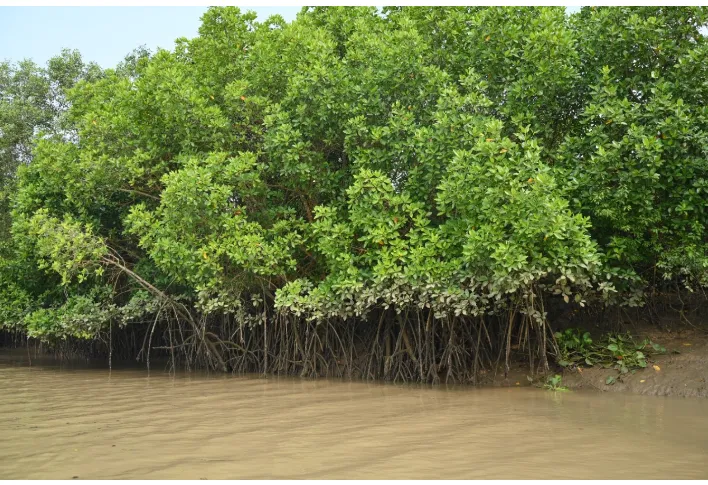
Bhubaneswar, April 18: Odisha is emerging as one of India’s leading models in mangrove restoration, yielding substantial ecological, economic, and climate benefits. The state currently boasts around 259.06 sq. km of mangrove forests across five coastal districts, with Bhitarkanika National Park in Kendrapara district contributing over 212 sq. km, making it one of the country’s most extensive and significant mangrove ecosystems.
Guided by scientific innovation, policy alignment, and active community involvement, Odisha has transformed its coastal ecosystems into robust green buffers that combat climate change. The state continues to expand its coastal conservation initiatives, supported by the Compensatory Afforestation Fund Management and Planning Authority (CAMPA), under the direction of the Forest, Environment, and Climate Change Department of the Government of Odisha.
 One of the standout features of Odisha’s approach is its integration of science-based monitoring with hands-on restoration efforts. Data buoys deployed by the National Centre for Sustainable Coastal Management (NCSCM) under the Odisha Forestry Sector Development Project (OFSDP) play an essential role in maintaining ecological balance in Bhitarkanika’s mangrove ecosystems. These buoys help identify pollution and environmental stress, enabling prompt corrective actions and reinforcing long-term restoration strategies.
“CAMPA’s financial backing has been crucial in scaling up these interventions. Beyond simple plantation, our focus includes ecological restoration activities such as deepening creeks to restore tidal flows and implementing fencing to curb human pressure on the ecosystems,” explained Varadaraj Gaonkar, Divisional Forest Officer (DFO), Mangrove Forest Division (Wildlife), Rajnagar.
Odisha is also introducing pioneering restoration techniques, including the “fishbone channel” model, designed to restore degraded tidal zones. This method, which enhances natural tidal water flow, has successfully regenerated approximately 100 hectares of mangrove cover in just four years in Bhitarkanika.
The state’s strategy goes beyond plantation and focuses on landscape-level restoration. Mangrove vegetation is concentrated across the districts of Kendrapada, Jagatsinghpur, Puri, Bhadrak, and Balasore. In the past four years alone, mangrove cover in Kendrapada has expanded by around 9.43 sq. km, while the entire state has seen an increase of 9.89 sq. km, according to the India State of Forest Report (ISFR). Restoring degraded mangrove areas, including encroached lands and those previously used for brackish water aquaculture, has reversed decades of ecological harm and revived vital coastal habitats.
A hallmark of Odisha’s mangrove restoration model is the strong community involvement in conservation efforts. With support from CAMPA, local communities actively participate in nursery development, planting initiatives, and safeguarding restored ecosystems, linking conservation efforts with livelihood generation and climate resilience.
 “Community participation has been the cornerstone of our success. Locals take part in planting activities, fostering a sense of ownership. The improved ecosystem health has also benefited livelihoods, particularly through fisheries and related industries,” said the DFO, Rajnagar.
The positive impact of these efforts is already evident. “Previously, high tides would flood our village, damaging roads, flooding homes, and even bringing crocodiles into the area. Now, the situation has improved significantly, offering the community renewed hope and security,” shared Uma Rani Giri, a resident of Kanaknagar village, under the Rajnagar Forest Division.
Odisha’s mangroves serve as more than just forests—they act as critical bio-shields against cyclones and storm surges, providing natural protection to areas often exposed to extreme weather events. Their dense root systems absorb wave energy, prevent coastal erosion, and stabilize shorelines. Additionally, they play a key role in carbon sequestration, support biodiversity, and boost fisheries, enhancing coastal livelihoods and food security.
 “CAMPA has been instrumental in supporting broader habitat restoration and scientific wildlife management efforts across the Bhitarkanika landscape, ensuring a more comprehensive and sustainable approach to ecosystem conservation,” emphasized the DFO.
Over the past decade, Odisha has recorded a 16.6% increase in mangrove cover, rising from 222 sq. km in 2011 to over 259.06 sq. km in 2023, according to the ISFR data. This ongoing growth solidifies Odisha’s position as a national leader in climate action, ecological governance, and nature-based resilience.