


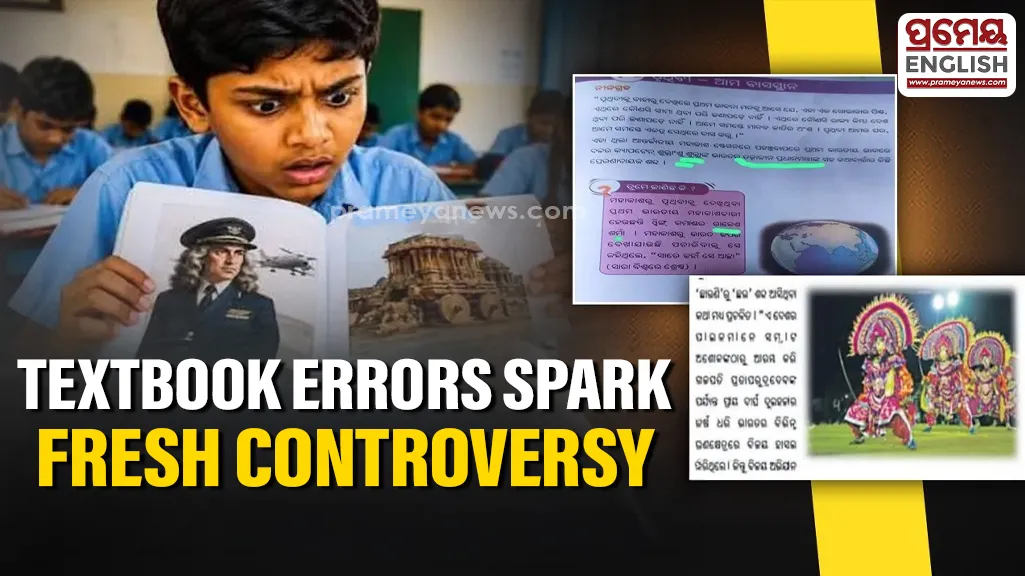
Bhubaneswar, Jul 7: Fresh controversy has erupted over Odisha's revised school textbooks after teachers flagged several factual, visual and contextual errors, alleging that the books misrepresent the state's art, culture and heritage. While spelling mistakes had already drawn criticism, educators now say the new textbooks for Classes I to VIII also contain inaccurate images, misleading information and omissions that could confuse students.
One of the most glaring errors has been found in the Class VI Odia textbook Sahitya Sudha. Although the chapter discusses the famous Mayurbhanj Chhau dance of Odisha, the accompanying photographs depict Purulia Chhau, a masked dance form associated with West Bengal and parts of Jharkhand. Teachers pointed out that Mayurbhanj Chhau is traditionally performed without masks, with dancers expressing emotions through facial expressions and eye movements, making it distinctly different from the Purulia style. Ironically, a small image of Mayurbhanj Chhau appears only at the end of the worksheet section instead of within the main lesson.
Another error has been identified in the Class III mathematics textbook Ganita Mela. A chapter titled "Joranda Mela" carries a photograph of Surajkund Mela, copied from an NCERT textbook, without any description or reference to the actual Joranda Mela of Odisha. Teachers allege that while Odisha-specific topics have been introduced in the text, the illustrations have simply been lifted from NCERT books without appropriate contextual changes.
The complaints extend to several other textbooks. In the Class VIII art education book Kruti, the photograph of renowned Odia writer Pandit Godabarish Mishra has allegedly been replaced with a "Vande Mataram" logo featuring the national flag. In another lesson, a reference to Achyutananda Das is accompanied by a picture of the Achyutananda monastery instead of the poet himself. Teachers have also claimed that the names of several prominent Odia literary figures have been misspelled.
Educators argue that while spelling mistakes can be corrected in classrooms, factual inaccuracies and misleading visuals are far more difficult to rectify and may distort students' understanding of Odisha's cultural identity.
Teachers have further alleged that the State Council of Educational Research and Training (SCERT) relied heavily on NCERT textbooks while preparing the new curriculum without adequately adapting the content to Odisha's context. They claim that images were reproduced without proper illustration work or copyright permissions, despite standard textbook development practices requiring subject experts and professional illustrators to prepare original visuals suited to the content.
Literary circles have also raised concerns that several poems and stories included in textbooks from Classes I to VIII do not mention the names of their authors. Writers had reportedly written to SCERT over the issue, but claim they have not received any response.
Apart from factual and visual errors, teachers have criticised the academic content of the new textbooks. They allege that important mathematical concepts such as geometry, trigonometry, mensuration, sets, polynomials and commercial mathematics have been removed from the Class VIII mathematics syllabus and replaced with unrelated narrative content.
Although the state government had assured that students would receive error-free textbooks, revised draft copies for Classes I to IV have already been uploaded on the websites of OSEPA and SCERT for corrections. However, teachers say the issue goes beyond typographical mistakes and requires a comprehensive review of the syllabus, content and illustrations.
The Primary School Teachers' Association has questioned whether SCERT will address these substantive errors, review the curriculum in detail and ensure that Odisha's history, culture and prominent personalities are represented accurately. The association also pointed out that lessons on Mahatma Gandhi, Gopabandhu Das, and freedom fighters associated with the Non-Cooperation Movement have been omitted from the Class III language textbook, while the Class IV language book reportedly contains the statement, "Odisha is my country," instead of placing Odisha within the broader national context.
Teachers have urged the government to undertake a thorough review of the textbooks before they are used extensively in classrooms, warning that inaccurate content could have a lasting impact on students' learning and understanding of Odisha's cultural heritage.