
.webp)


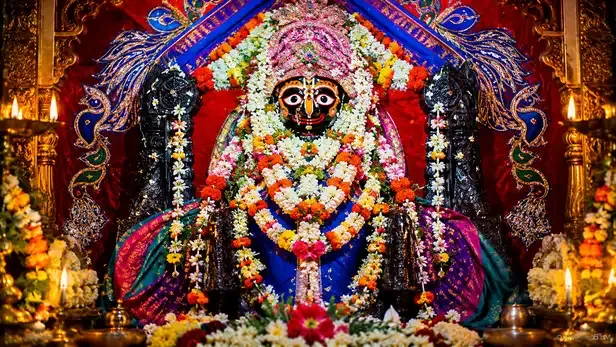
Brahmagiri, Jul 8: Barely 24 kilometres from Puri, nestled amid the serene surroundings of Brahmagiri, stands the revered Alarnath Temple, one of Odisha’s most sacred Vaishnavite shrines. Every year, when Lord Jagannath remains away from public view during the Anasara period following Snana Purnima, thousands of devotees flock to this temple to seek the blessings of Lord Alarnath, a four-armed manifestation of Lord Vishnu.
Yet, beyond its religious significance lies a heart-touching legend that has been passed down through generations—a story of innocent devotion, divine grace, and a miraculous burn mark that devotees believe can still be seen on the deity today.
According to temple tradition, the deity of Lord Alarnath was once worshipped by a devoted priest named Sri Ketan, who lived with his wife and young son, Madhu. The family survived solely on the Mahaprasad offered to the Lord each day. Before leaving for an urgent journey to a nearby village, Sri Ketan entrusted his young son with the responsibility of offering food to the deity.
Madhu hesitated, admitting that he knew neither the sacred mantras nor the rituals required for worship. His father reassured him with a simple instruction: place the food before the Lord with sincerity and request Him to accept it.
The next morning, carrying a plate of freshly prepared food, Madhu stood before the deity and prayed with folded hands.
"O Lord, I do not know the rituals or mantras. My father asked me to offer this food to You. Please accept it."
Believing the Lord would eat as He did when his father performed the ritual, the innocent boy left to play with his friends. On returning, he found the offering untouched.
Thinking the Lord had not heard him, Madhu pleaded once again before going back outside. Even after a second attempt, the food remained untouched. The little boy then broke down in tears.
"Please eat, Lord. I am only doing what my father told me. If You don't accept this offering, he will be upset with me."
Moved by the child's unwavering faith and pure heart, Lord Alarnath is believed to have manifested from the stone deity and accepted the entire offering.
When Madhu returned and found the plate empty, he joyfully carried it home. However, his mother refused to believe his story, accusing him of eating the food himself. Despite repeated insistence that the Lord had consumed the offering, no one believed him. As there was no Mahaprasad left, the family observed a fast that day.
The same miracle reportedly continued for the next three days.
When Sri Ketan returned, he was astonished by his son's account but remained sceptical. Determined to discover the truth, he asked Madhu to perform the offering once more while he secretly watched from behind the sanctum.
As the innocent child offered the food with the same heartfelt prayer, Lord Alarnath once again manifested before him. The deity reached for a bowl of hot kheer (sweet rice) to accept the offering.
Unable to believe what he was witnessing, Sri Ketan rushed forward and grabbed the Lord's arm in an attempt to stop Him. In the process, the steaming kheer spilled over the deity's hand and body, leaving burn marks.
Overwhelmed, the priest questioned the Lord.
"How can a stone deity eat? If You consume all the offerings, how will we survive?"
Lord Alarnath is believed to have then revealed a profound spiritual truth—that He is not pleased by elaborate rituals alone but by pure love and unwavering devotion.
The message echoes the teachings of the Bhagavad Gita, where Lord Krishna declares that He accepts even the simplest offering-a leaf, a flower, a fruit or water-when it is offered with sincere devotion.
The miracle transformed Sri Ketan's understanding of worship forever. It became a timeless reminder that the Lord responds not to ritualistic perfection but to the innocence and surrender of a devotee's heart.
Temple priests and devotees continue to believe that the burn marks caused by the hot kheer remain visible on the deity of Lord Alarnath even today. Visitors to the ancient shrine are often shown the sacred marks, which are revered as enduring testimony to the extraordinary devotion of a little boy whose simple faith compelled the Divine Himself to accept his offering.
For devotees, the legend of Madhu and Lord Alarnath is more than folklore—it is a living lesson that true devotion transcends ritual, and that the purest prayers are those offered with absolute faith and unconditional love.
.webp)