

.webp)
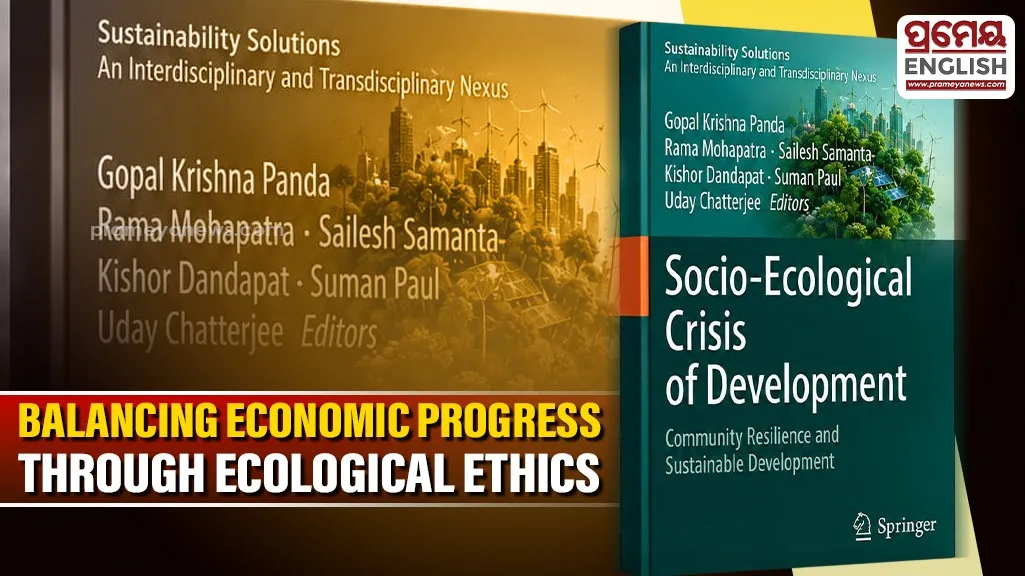
Scholars propose fresh frameworks balancing human progress with nature
Global economic expansion requires an immediate, radical re-evaluation as unchecked industrial progress pushes planetary boundaries toward an irreversible tipping point. A newly published volume, Socio-Ecological Crisis of Development: Community Resilience and Sustainable Development, addresses this precise friction. The authors challenge conventional growth models by merging cutting-edge scientific tools with localized indigenous knowledge. Data shows the planet's average temperature climbed roughly 0.6 degrees Celsius over the past century, with projections warning of a 1.4 to 5.8 degrees Celsius spike this century if emissions continue unabated. This looming threat positions the current climate dilemma as the defining challenge of our era.
Mapping Vulnerability with Advanced Technology
Modern research now utilises sophisticated tech toolkits to observe environmental decay. This volume highlights how investigators use advanced geostatistical modeling, geospatial mapping, artificial intelligence, and machine learning to trace ecological shifts. By applying these digital tools to field data across India, Indonesia, and Vietnam, the researchers expose exactly how rapid urbanization strains local ecosystems.
Odisha's own coastal belt frequently mirrors these global vulnerabilities. The state's recurring encounter with intense Bay of Bengal cyclones serves as a regional parallel to the book's deep-dive analysis of the Sundarbans, where communities constantly adapt to severe flood hazards and shifting coastlines.
The text divides its investigation into three clear areas, beginning with the systemic clash between infrastructure expansion and societal well-being. Early chapters analyse the impacts of neo-urbanization, questioning whether technological upgrades actually protect the environment or simply mask ongoing degradation.
Community Dynamics and Field Insights
The second section of the book evaluates real-world survival strategies. Eight detailed chapters explore highly specific threats, including earthquake vulnerability, community coping mechanisms, and the terrifying reality of soil contamination by toxic metalloids which directly threatens human health.
|
Risk Factor |
Analytical Tool |
Core Objective |
|
Flood Hazards |
Spatial Analysis |
Map social vulnerability |
|
Soil Contamination |
Metalloid Tracking |
Protect public health |
|
Coastal Shifts |
Resilience Frameworks |
Support Sundarbans |
The data shows that top-down government policy rarely succeeds without grassroots cooperation. This intersection proved vital during recent global disruptions, including the institutional responses required during the COVID-19 pandemic.
Frameworks for Lasting Survival
True progress links economic survival with green space preservation. The final portion of the book focuses entirely on executable strategies, drawing heavily from Southeast Asian initiatives.
Indonesian case studies illustrate successful green programs, such as integrating agricultural practices with eco-tourism to generate sustainable livelihoods. Additionally, evaluations of Indonesia's specialized Climate Village Program offer a blueprint for local adaptation and mitigation. Additional research validates the importance of urban green spaces in maintaining neighborhood health. Ultimately, the authors demonstrate that meaningful survival policies emerge only when scientific insight blends seamlessly with community wisdom, shifting our relationship with nature from exploitation to active restoration.
Book Review: Socio – Ecological Crisis of Development; Editors Gopal Krishna Panda, Rama Mohapatra, Sailesh Samanta, Kishor Dandapat, Suman Paul, Uday Chaterjee
.webp)