

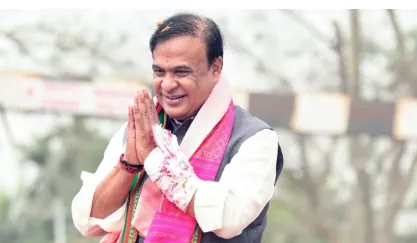
New Delhi, May 4: The Bharatiya Janata Party (BJP) has secured a resounding victory in Assam, marking a significant stride in both its political journey and the BJP-led National Democratic Alliance’s (NDA) dominance in the state. Himanta Biswa Sarma has been re-elected as Assam’s Chief Minister, steering his second consecutive term under the banner of his “security and growth” agenda. With the NDA securing a majority in the 126-member Assam Legislative Assembly, it has won in 102 seats.
However, these results are not just a triumph for the BJP’s leadership but also reveal the growing religious polarisation in the state. While the BJP dominated the indigenous and urban sectors, the Muslim vote was split, with Congress and the All India United Democratic Front (AIUDF), led by Badruddin Ajmal, competing for support. In the 2026 election, the BJP increased its vote share to 38.59%, up from 33.6% in 2016. This 5% rise can largely be attributed to the consolidation of the Hindu vote behind the party, while the Muslim vote fragmented.
AIUDF, struggling with the effects of constituency delimitation, saw its vote share drop to a mere 5.29%, down from 9.4% in 2016. Congress remained relatively stable, with a slight dip from 30% in 2021 to 29.26% in 2026, primarily drawing its support from Muslim voters, with 18 out of its 19 leading candidates being Muslim.
The standout moment of the election came in the Jalukbari constituency, where Chief Minister Himanta Biswa Sarma defeated his Congress rival with a resounding margin of over 80,000 votes, securing 112,186 votes. However, the biggest shock was Congress's loss in the Jorhat constituency, traditionally a stronghold of the Gogoi family. Gaurav Gogoi, the Congress stalwart, was defeated by BJP's Hitendra Nath Goswami by a margin of 23,182 votes, signaling the end of the Gogoi family's political dominance in Upper Assam.
As per the latest data from the Election Commission of India, the BJP has won 30 seats and is leading in 52. Its allies, the Asom Gana Parishad (AGP) and Bodoland People's Front (BPF), have secured leads in 20 seats. Congress, with its alliance partner Raijor Dal (RJRD), is leading in 18 seats, having won only one, while AIUDF has won one and is leading in another.
Union Minister Sarbananda Sonowal and Assam BJP President Dilip Saikia hailed the victory as a "historic mandate," reflecting the party's growing influence in both Assam and the broader Northeast region. Sonowal expressed his gratitude to the people of Assam, recognizing the faith they placed in the leadership of both Prime Minister Narendra Modi and Chief Minister Sarma. He remarked, "This victory is a testament to the dedicated service of PM Modi and CM Himanta Biswa Sarma, and the people’s trust will accelerate Assam's journey toward rapid growth."
Saikia echoed this sentiment, emphasizing that the results marked a new chapter in Assam's political landscape, strengthening the BJP's role under Modi’s leadership.
With the BJP firmly in control of Assam, the state has now shifted to a two-party contest, dominated by the BJP and Congress, sidelining regional and sectarian players like AIUDF. The 2026 election marks a comprehensive victory for Sarma, who has not only retained power but has also reshaped the political fabric of Assam, ushering in an era where regional forces struggle to maintain influence.