
.webp)


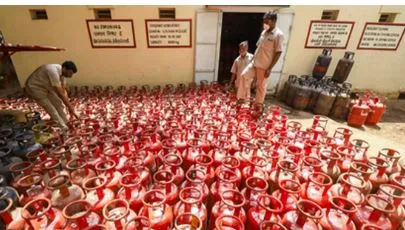
New Delhi, August 16: The government has set maximum LPG production levels for 24 refinery and upstream oil companies, establishing a combined production potential of 63.81 thousand metric tonnes per day (KTPD) as part of efforts to strengthen domestic cooking gas supplies and improve resilience against supply disruptions.
The Ministry of Petroleum and Natural Gas, in an order dated August 13, specified production levels for 18 public-sector refineries, three private-sector companies and three upstream oil producers.
Reliance Industries has the highest specified LPG production potential at 18 KTPD, followed by BPCL's Kochi refinery at 4.80 KTPD and Nayara Energy at 4.48 KTPD. Together, these three account for 27.28 KTPD, or a substantial share of the total production potential.
The order amends the Petroleum Products (Maintenance of Production, Storage and Supply) Order, 1999, and introduces specific operational directions for LPG production and supply.
Under the new framework, public-sector, joint-venture and private-sector refineries, as well as upstream oil companies, must develop and maintain adequate infrastructure for LPG storage, evacuation and transportation in line with their specified production capacities.
Companies have also been directed to adopt technically and economically viable measures to maximise LPG output beyond their existing minimum producible quantities. Such measures may include naphtha-to-LPG conversion technologies and the upgrading of gasoline-based fluid catalytic cracking units into petro-fluid catalytic cracking units.
The government has retained the authority to direct refiners, oil marketing companies and upstream producers to increase LPG production by specified quantities for a defined period whenever higher domestic availability is considered necessary in the public interest.
Such directions may also include restrictions on alternative uses of input streams required for LPG production. Companies will be required to raise output within the timeframe stipulated by the government.
The production schedule will be reviewed and updated twice a year, on January 1 and July 1. The revisions will take into account new refineries and upstream companies, as well as additional LPG production resulting from improvements in infrastructure, technology, evacuation, transportation and distribution facilities.
Implementation of the order will be monitored by the Centre for High Technology or another agency authorised by the government. Any violation of directions issued under the order will be punishable under the Essential Commodities Act, 1955.
The move provides the government with a more structured mechanism to manage domestic LPG production and ramp up supplies when required. By strengthening domestic production capabilities and infrastructure, the framework could help reduce vulnerability to external supply disruptions and support more stable availability of cooking gas across the country.
.webp)