

.webp)



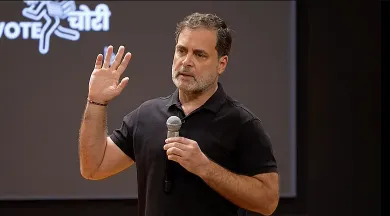
New Delhi, November 28: Congress leader and Leader of Opposition in the Lok Sabha Rahul Gandhi on Saturday launched a sharp attack on the BJP-led Centre over its proposed delimitation exercise, alleging that the move would undermine social justice and weaken the political representation of marginalised communities.
Addressing a press conference at the All India Congress Committee (AICC) headquarters in New Delhi, Gandhi accused the government of sidelining the caste census and making the 2027 Census irrelevant to the proposed delimitation process. He alleged that the government intended to rely on the 2011 Census figures and freeze the share of seats until 2051, thereby denying Scheduled Castes (SCs), Scheduled Tribes (STs) and Other Backward Classes (OBCs) adequate representation despite changes in their population.
"The caste census has been put aside, and the 2027 Census has been rendered irrelevant. Why? Because it is going to show some very inconvenient facts, which the BJP does not appreciate. So they are going to use the 2011 Census, and everything is going to be frozen till 2051. Means for 40 years, you can forget social justice," Gandhi said.
He further alleged that the proposed exercise would undermine the rights of SCs, STs, OBCs and minorities. Pointing out that the population of SCs and STs would increase while their share of reserved seats remained frozen, he questioned the government's approach to representation.
Gandhi also objected to the proposed expansion of the Lok Sabha to 850 seats and demanded the formation of a bipartisan Delimitation Commission. He said the Congress favoured implementing 33 per cent women's reservation within the existing strength of 543 Lok Sabha seats rather than increasing the House's strength, while ensuring a sub-quota for OBC women.
"On seats, they want 850, while we say maintain the current seats. They say use the 2011 Census, while we say no, social justice requires and the law requires that we use the latest census, using 2027 caste census data. We want a bipartisan Delimitation Commission. They want women's reservation at 850, and we say at 543, with a sub-quota for OBCs," he said.
Questioning the government's intentions, the Congress leader alleged that the proposed legislative changes could give the BJP an opportunity to reshape the country's democratic framework. "The question here is giving the BJP a blank slate to reshape the foundations of Indian democracy," he added.
Meanwhile, President Droupadi Murmu on Saturday recommended that the Lok Sabha consider the Delimitation (Second) Bill, 2026, under Article 117(3) of the Constitution, fulfilling a key procedural requirement ahead of the Parliament session scheduled to begin on November 30.
The recommendation came a day after the Union Cabinet approved a revised legislative package comprising the Constitution (132nd Amendment) Bill, 2026, the Delimitation (Second) Bill, 2026, and the accompanying Union Territories Laws Amendment Bill.
The government is expected to withdraw the Bills introduced in April, which remained stalled after the Constitution (131st Amendment) Bill failed to secure passage in the Lok Sabha, and introduce the revised versions on Monday.
The revised proposals envisage a uniform 50 per cent increase in the maximum strength of the Lok Sabha and State Legislative Assemblies across the country. Accordingly, the maximum strength of the Lok Sabha is proposed to rise from 550 to 850, while that of State Assemblies would increase from 500 to 650.
The package also proposes redrawing constituencies within each state based on the latest published Census figures, currently the 2011 Census, while keeping the relative share of seats among states frozen until 2051.
The proposed delimitation exercise is intended to facilitate the implementation of 33 per cent reservation for women in the Lok Sabha and State Legislative Assemblies ahead of the 2029 General Elections.
.webp)