


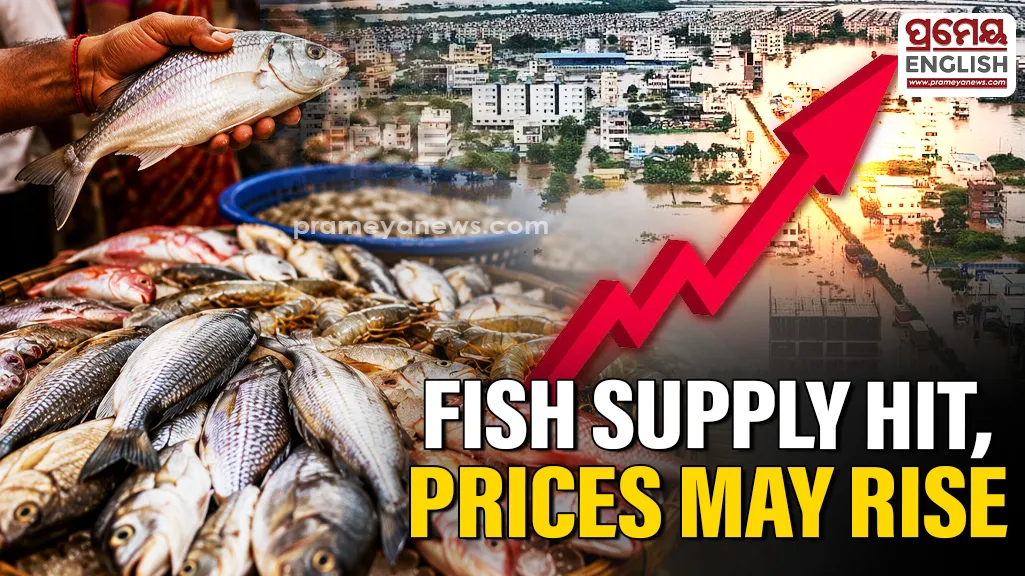
Bhubaneswar, July 21: The ongoing rains and floods have begun affecting the non-vegetarian market in Odisha, with prices of essential items like eggs and mutton already witnessing a rise. Now, fish prices are also expected to increase due to a shortage in supply caused by flood-related disruptions in Andhra Pradesh.
Fish production in Andhra Pradesh has declined due to the prevailing flood situation, affecting the supply chain to Odisha. Traders said that the number of fish-laden trucks arriving from Andhra Pradesh has reduced significantly. While around 10 trucks used to arrive regularly, only five reached Odisha last Saturday. The supply is expected to decline further in the coming days, raising concerns of a possible fish shortage in markets across the state, including Bhubaneswar.
Odisha depends heavily on Andhra Pradesh to meet its growing fish demand, as local production is insufficient. Usually, 10 to 12 trucks carrying fish, crabs, prawns, and marine fish reach Bhubaneswar on the day before the weekly non-vegetarian market day. Around 60 such vehicles supply fish to different parts of the state, including Cuttack, Nayagarh, Balangir, Kalahandi, Ganjam, Balasore, and Jagatsinghpur.
Bhubaneswar alone receives around 1,100 quintals of fish, with varieties such as rohu, bhakura (catla), and jalanga being among the most popular. Tiger prawns also have strong demand among consumers. Nearly 700 quintals of fish are sold in the city every day, while the remaining stock is carried forward for sale the following day.
Traders warned that limited supply could push up fish prices in the coming days. Currently, rohu is sold at around ₹180–₹240 per kilogram, while bhakura costs between ₹240 and ₹300 per kilogram. A further rise in prices could put additional pressure on consumers already facing higher costs of vegetables, onions, ginger, sugar, and cooking oil.
The shortage of Andhra fish, combined with rising prices of mutton, chicken, and eggs, has added to the concerns of non-vegetarian consumers. According to a government survey, around 94.75% of Odisha’s population consumes fish. During 2024–25, the annual per capita fish consumption in the state stood at 19.16 kilograms, making steady supply a major concern.
Meanwhile, egg prices continue to remain high at around ₹9 per piece despite efforts to control prices. Traders have been accused of charging higher rates arbitrarily, prompting calls for stricter monitoring by authorities.
The rise in egg prices has also affected the preparation of midday meals in government schools. While the government has fixed the egg cost at ₹7 per piece under the scheme, market prices have increased to ₹9–₹10. Schools receive ₹11.15 per primary student and ₹14.74 per upper-primary student for midday meals, but teachers are now facing difficulties in managing costs due to the sharp rise in egg prices.