
.webp)


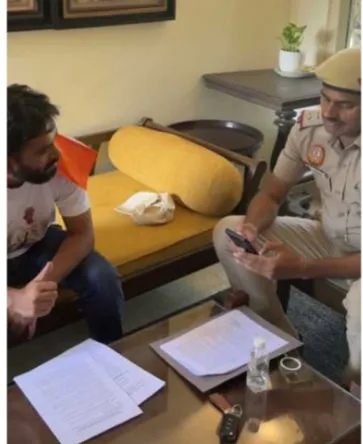
New Delhi, October 16: Delhi Police have served a notice on Cockroach Janta Party (CJP) activist Abhijeet Dipke, warning that holding a proposed Tiranga Yatra in the Connaught Place area without the requisite permission could violate restrictions imposed under Section 163 of the Bharatiya Nagarik Suraksha Sanhita (BNSS).
Police personnel visited the residence where Dipke was staying in the national capital and served him the notice in the presence of a police official. The notice stated that prohibitory restrictions under Section 163 were in force in and around Connaught Place. It also noted that the New Delhi Municipal Council (NDMC) had not granted permission for the proposed Tiranga Yatra scheduled for Saturday.
The notice warned that proceeding with the march in Connaught Place without permission could be treated as a violation of the restrictions and invite legal action.
Dipke was reportedly informed that waving the national flag was not prohibited by law. However, organising an unauthorised procession or assembling a crowd in violation of the prevailing restrictions could invite police action. He was also reminded of the requirement to handle and display the national flag with due respect in accordance with the Flag Code of India.
Dipke defends peaceful protests, questions administrative restrictions
Earlier, Dipke rejected allegations that the CJP was promoting disorder, arguing that demanding accountability from those in power was not an act of anarchy but a fundamental democratic right.
In a post on social media platform X, the CJP activist disputed claims that public demonstrations were responsible for disrupting economic activity. He argued that administrative restrictions, citywide shutdowns and movement curbs could cause greater hardship to businesses, traders and ordinary citizens.
“Businesses do not suffer because of peaceful protests. They suffer when the govt decides to shut down an entire city, suspend internet services and restrict the movement of its own citizens and turn the city into a war-zone,” Dipke said.
He maintained that the CJP had consistently followed the principles of peace and non-violence associated with Mahatma Gandhi. According to Dipke, the party had organised protests in Mumbai, Pune, Jaipur, Lucknow, Bengaluru and Nagpur, all of which he described as peaceful.
Recalling an alleged assault on him during a protest in Jaipur, Dipke said he had chosen not to retaliate, asserting that responding to violence with violence would contradict the party's stated principles.
“We would rather exercise the rights guaranteed to us by the Constitution, drafted under the leadership of Dr B R Ambedkar, than resort to physical force,” he said.
CJP founder alleges double standards over protests
Dipke also criticised what he described as attempts to portray demonstrators as anarchists simply for questioning the government and protesting against perceived injustice.
“Demanding answers from the govt is not anarchy, protesting against injustice on the streets is not anarchy, and questioning those who hold public office is certainly not anarchy,” he said.
The CJP founder argued that the political establishment currently in power had itself relied on street protests and public demonstrations while in opposition. He alleged that restrictions and police action against protesters were being applied differently depending on whether a party was in government or opposition.
“It is deeply hypocritical to celebrate protests as a democratic right when you are in opposition and treat the same act as a threat to public order when you come to power,” Dipke added.
Emphasising the importance of constitutional freedoms, he said citizens were not seeking special privileges but wanted to exercise rights available to everyone, irrespective of the political party in power.
“A govt that has been elected by the people is bound to listen to the people, not silence them. Democracy does not end once the votes have been counted,” he said.
Security tightened around Connaught Place
Dipke's remarks come amid heightened security arrangements in and around Connaught Place ahead of the proposed “Lehra Do Tiranga” protest called by the CJP activist at Central Park.
The Delhi Traffic Police also warned that traffic movement on certain roads in and around Connaught Place could be affected from 3 pm on Friday as part of the arrangements.
The proposed demonstration has drawn attention to the balance between the right to peaceful assembly and the enforcement of restrictions imposed by authorities to maintain public order. While Dipke has defended the proposed protest as an exercise of constitutional rights, the police notice has made clear that any procession must comply with the applicable restrictions and permission requirements.
.webp)