

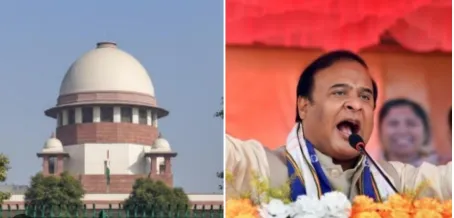
New Delhi, February 17: The Supreme Court of India on Tuesday dismissed a public interest litigation (PIL) filed by twelve petitioners, including former Delhi Lieutenant Governor Najeeb Jung and academic Roop Rekha Verma, who had sought the formulation of guidelines to ensure constitutional morality in the conduct of public officials, constitutional functionaries, and executive administrators.
The petition specifically highlighted alleged discriminatory remarks made by Assam Chief Minister Himanta Biswa Sarma and Uttar Pradesh Chief Minister Yogi Adityanath, among others, and called for measures to address such statements by public figures.
A three-judge bench, led by Chief Justice of India (CJI) Surya Kant, along with Justices Joymalya Bagchi and BV Nagarathna, expressed concern over the selective nature of the petition. "The petitioners are respected individuals, but it is unfair to target only selected persons while conveniently ignoring others," the bench remarked. They stressed that a plea framed with impartiality and objectivity would be more appropriate for consideration.
Senior advocate Kapil Sibal, representing the petitioners, raised the issue of increasingly toxic public discourse, emphasizing the need for intervention. "This has become a toxic environment, and only this Court can address it," he said. Sibal also offered to remove any personal allegations from the petition.
However, the Court raised doubts about the effectiveness of judicial guidelines in such matters. Justice BV Nagarathna questioned the feasibility of judicial intervention, saying, "There should ultimately be restraint on all sides. If the Court gives guidelines, why can’t there be self-restraint and self-regulation? It is about preserving fraternity in the country." Justice Joymalya Bagchi also pointed out concerns over compliance, noting that judicial orders are only effective when followed, and breaches can only be addressed after the fact.
On the broader issue of regulating public discourse, the CJI emphasized the distinction between public servants and public figures. "Political parties should adhere to constitutional morality and mutual respect, which should apply uniformly across the board," said CJI Surya Kant. He further remarked that while laws, rules, and mandates for public servants are already in place, a similar framework for public figures could be explored.
In light of the Court's observations, Sibal requested permission to withdraw the petition and assured the Bench that a revised, comprehensive plea would be filed. The Court allowed the withdrawal, urging the petitioners to approach the matter as a constitutional exercise rather than a populist one. "Let it not be a populist exercise, but a constitutional exercise," Justice Bagchi concluded.