

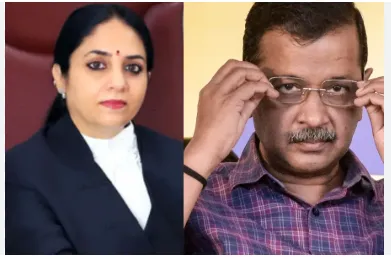
New Delhi, April 20: The Delhi High Court dismissed Delhi Chief Minister Arvind Kejriwal’s plea seeking the recusal of Justice Swarana Kanta Sharma in the excise policy case. The Court stated that the allegations made in the plea were based on mere conjecture and did not meet the legal threshold required to establish a reasonable apprehension of bias.
Leading with pointed remarks, the Court underscored that "the courtroom cannot become a theatre of perception," cautioning that even influential political figures cannot be allowed to make baseless accusations against sitting judges without substantiated evidence. The judgment stressed that the standard of fairness must be maintained, particularly when allegations are levied against the judiciary, and that entertaining such requests would undermine institutional credibility.
Justice Sharma observed that the petitioner's case was constructed on "insinuations and aspersions" rather than credible proof, and accepting such claims would set a dangerous precedent. The Court emphasized that a judge should not be compelled to recuse simply due to a litigant's fear of an adverse ruling, stating that "justice cannot be managed through perception."
Addressing the claim of perceived bias, the Court pointed out the inconsistency in the petitioner’s position: although asserting that the judge's integrity was not in question, Kejriwal still sought her recusal based on mere apprehension. The Court noted that this effectively put the judiciary on trial, which was a stance incompatible with the rule of law.
On the matter of alleged conflict of interest, raised due to Justice Sharma’s children being empanelled as Central Government counsel, the Court ruled that no direct connection with the current case had been proven. It clarified that while judges swear an oath of office, their family members are not restricted from pursuing their careers, and litigants cannot dictate their personal or professional choices.
The Court also dismissed the notion that the judge's participation in public or professional events could be grounds for bias. It reiterated that there had been no specific political statements made by Justice Sharma that could suggest bias, and involvement in legal or academic activities does not compromise judicial neutrality.
Addressing claims that some earlier orders had been overturned, the Court reaffirmed that judicial competence is evaluated by higher courts, not litigants. It pointed out that in the instances cited by Kejriwal, the Supreme Court had not issued any adverse remarks about the High Court’s rulings.
Justice Sharma further highlighted the problematic nature of the plea, describing it as a "catch-22" scenario: if the Court had recused itself, it would have validated the allegations; if it did not, the decision would still be challenged. The Court made clear that such tactics, aimed at undermining both the judge and the institution, could not be tolerated.
Reaffirming the weight of judicial responsibility, the Court remarked, "The robe this Court wears is not so light," asserting that it would protect both the integrity of the institution and its own standing. The judgment concluded that the recusal application lacked merit and that the apprehensions expressed did not meet the legal criteria. Allowing such claims, the Court warned, would open the doors to attempts to manipulate judicial proceedings.
The case pertains to the Delhi Excise Policy 2021-22, where the CBI has challenged the discharge of Arvind Kejriwal, Manish Sisodia, and others. With the recusal plea now rejected, the Delhi High Court is poised to proceed with the case on its merits