


Rayagada, August 8: In Rayagada, devotion takes on the warmth of a family tradition. Every year during the month of Ashadha, hundreds of devotees come together to celebrate a ritual that is as much about love and emotion as it is about faith. The centre of this tradition is ‘Maa Majhighariani’, the presiding deity of Rayagada, whom the Telugu-speaking community lovingly considers their own daughter.
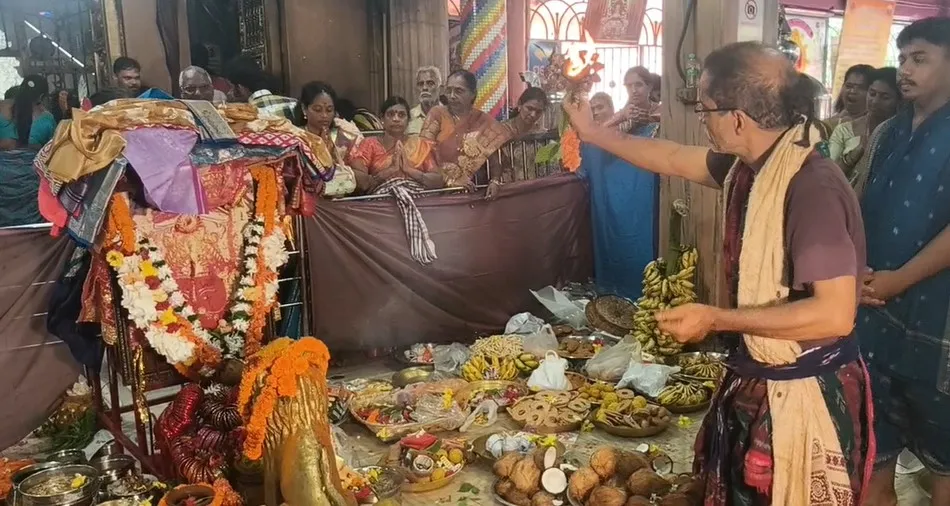
As part of the ritual, devotees prepare 56 varieties of bhog, with each variety offered in 108 plates. The offerings are accompanied by new clothes, bangles, vermilion, jewellery, fruits and a host of traditional delicacies.

It is not simply a religious offering.
It is a ‘Bhara’—a traditional bundle of gifts prepared for a daughter as she leaves her maternal home.
The ritual is observed on a Friday during Ashadha, following a long-standing Telugu tradition. According to the custom, married daughters return to their maternal homes during Ashadha and, when they leave for their in-laws’ homes, their families send them off with sweets, clothes, jewellery and other gifts.
In Rayagada, the same emotion is expressed towards Maa Majhighariani.
The goddess is treated as a daughter of the community, and devotees prepare her ‘Bhara’ with the same affection and care that a family would show to its daughter.
As the ritual begins, the sound of traditional drums fills the air. Women and young devotees dance to the rhythm, while thousands gather around the temple premises in a festive and spiritual atmosphere. devotees walk barefoot, carrying baskets filled with offerings.
There are sweets and traditional delicacies, fruits, cakes, bangles, vermilion, jewellery and a new red sari—all carefully arranged as part of the ‘Bhara’.
For those taking part, every item carries a sentiment.
It is their way of saying: “You are our daughter, and we send you back with our love and blessings.”
“During the month of Ashadha, we offer ‘Bhara’ to Maa Majhighariani because we consider her our daughter—the daughter of our community. Just as a daughter receives different things when she leaves her maternal home, we also prepare a ‘Bhara’ for Maa with sweets, cakes, fruits and many other items. We offer everything with devotion and affection. We believe that Maa fulfills our wishes and blesses us with good health and a happy life, says Janki Rani Patnaik, a devotee.

The tradition has deep roots in Telugu culture and is closely connected to the community’s way of observing the lunar calendar.
While the Odia tradition generally follows the cycle from one full moon to the next, the Telugu calendar traditionally follows the new-moon cycle.
During Ashadha, married daughters are welcomed into their maternal homes. And when it is time for them to return to their in-laws’ homes, their families prepare a ‘Bhara’ filled with food, new clothes, bangles, vermilion and jewellery.
In Rayagada, this centuries-old cultural practice has found a sacred expression.
Maa Majhighariani becomes the daughter.
The devotees become her family.
And the ‘Bhara’ becomes a symbol of affection, blessings and hope.
“Mostly, the ritual is predominantly observed by the Telugu community in the area and has been celebrated in its present form for the past several years. It is performed with great devotion, and people believe that Maa’s blessings bring happiness and prosperity to their families, say Chandra Pujari, the Chief servitor of the temple.”

And so, as thousands gather at the temple, carrying offerings on their heads and prayers in their hearts, an old family tradition comes alive once again.
A daughter is being sent home.
A goddess is being worshipped.
And in Rayagada, the two have become one.