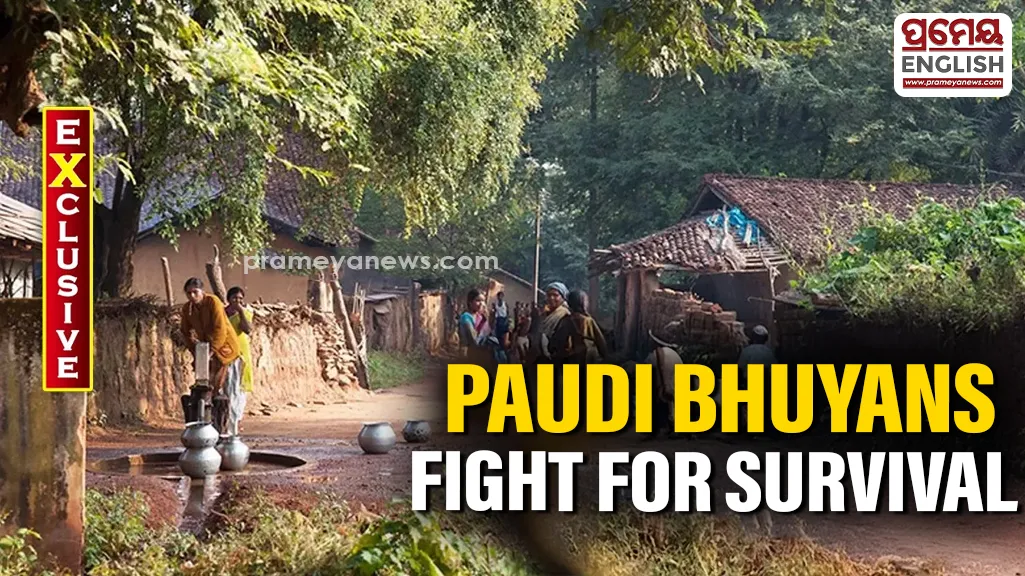
Sundargarh, July 23: Their fragile bodies tell a story of deprivation. Children with visible ribs, underweight for their age, and swollen stomachs reflect the deep-rooted crisis of malnutrition. Women, too, bear the scars of prolonged nutritional neglect, with anaemia affecting a large section of the community. Diseases that should not define young lives are taking hold early, leaving many families battling a cycle of poor health, poverty, and uncertainty.
This is the harsh reality faced by the Paudi Bhuyan community, one of Odisha’s Particularly Vulnerable Tribal Groups (PVTGs). Despite decades of government welfare initiatives, the community continues to struggle for basic survival. A recent study by the Centre of Excellence for Regional Development and Tribal Studies at Sambalpur University has brought to light the alarming social, economic, and health conditions of this indigenous community in western Odisha.
The findings reveal a disturbing picture: 68 percent of children among the Paudi Bhuyans suffer from malnutrition, while 64 percent of women are affected by anaemia. Beyond nutrition, the community faces multiple challenges in education, healthcare, livelihood security, and access to basic services.
A study revealing a silent crisis
Conducted under the leadership of Professor Arun Kumar Acharya, the research assessed the vulnerability of Paudi Bhuyans living in Sundargarh district. The study covered 318 families out of 1,060 households across Lahunipada, Koida, Bonai, and Gurundia blocks.
Researchers examined six key aspects of community life—livelihood, nutrition, health, education, living standards, and cultural identity. The findings indicate that, despite the presence of several government schemes, the community remains highly vulnerable and continues to face serious threats to its survival.
Living between forests and hardships
For generations, the Paudi Bhuyans have maintained a close relationship with forests. Their traditional livelihood depends largely on forest produce collection and podu cultivation (shifting agriculture) in hilly terrains. However, the absence of productive assets and limited economic opportunities have pushed many families into deeper poverty.
With few alternative sources of income, households remain dependent on fragile livelihood systems that are increasingly unable to support their nutritional and financial needs.
Education: A distant dream for many children
Education remains another major challenge. The literacy rate among Paudi Bhuyan women stands at only 38 percent, while the average educational attainment among both men and women remains limited to the third or fourth standard.
School dropout rates are significantly high, with distance emerging as one of the biggest barriers. Many villages do not have nearby schools, forcing children to travel more than five kilometres to attend classes. For families struggling with poverty and daily survival, continuing education often becomes difficult.
A battle for basic healthcare
Health remains the community’s biggest concern. The survey highlights widespread malnutrition among children and anaemia among women, conditions often linked to inadequate diets and poor access to healthcare.
The community also faces the burden of diseases such as malaria and kidney-related illnesses. Many Paudi Bhuyan villages lack nearby medical facilities, with primary health centres often located at least 10 kilometres away. As a result, several families continue to depend on traditional herbal treatments due to limited access to modern healthcare.
Unsafe drinking water further worsens the situation. Many households rely on streams and ponds, while essential facilities such as roads, electricity, sanitation, and clean water remain unavailable in several settlements.
Government schemes yet to reach their full potential
Various welfare programmes—including food security initiatives, agricultural support schemes, Eklavya Model Residential Schools, and pre- and post-matric scholarships—have been introduced to support tribal communities. However, the Paudi Bhuyans have not been able to fully benefit from these interventions due to challenges such as geographical isolation, lack of awareness, and limited accessibility.
The study recommends stronger implementation of government programmes, improved education infrastructure, better healthcare facilities, and sustainable livelihood opportunities to ensure meaningful development.
Protecting a vanishing heritage
Odisha is home to the largest number of Particularly Vulnerable Tribal Groups in India. Among the 13 PVTG communities in the state are the Bonda, Dongria Kondh, Kutia Kondh, Lanjia Saora, Mankidia, Chuktia Bhunjia, and Paudi Bhuyan communities.
With a population of only around 14,000 in Odisha, the Paudi Bhuyans primarily inhabit Sundargarh, Sambalpur, Deogarh, Angul, Keonjhar, and Mayurbhanj districts. Their unique traditions, clothing, agricultural practices, and cultural identity represent an important part of Odisha’s tribal heritage.
But survival has become their greatest challenge. Preserving the Paudi Bhuyan community requires more than welfare schemes on paper—it demands sustained action, stronger infrastructure, and a development approach that respects their culture while addressing their urgent needs.
For a community standing at the margins, the question is no longer only about development—it is about ensuring that an ancient identity does not disappear silently.