

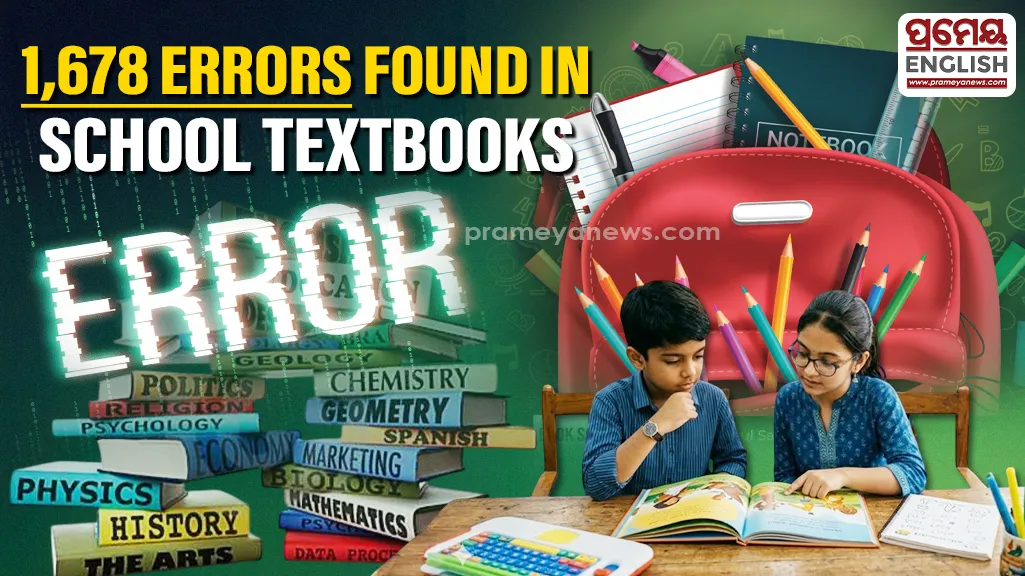
Bhubaneswar, June 16: Serious concerns have emerged over the new school textbooks introduced under the National Education Policy (NEP) 2020 after as many as 1,678 errors were identified in books meant for Classes I to VIII. The textbooks have already been distributed to students across schools, prompting criticism from parents, teachers and educationists.
The errors range from spelling mistakes and factual inaccuracies to incorrect names of eminent personalities and geographical locations. Among the major errors reported are the use of a photograph of the Karnataka Legislative Assembly in place of the Odisha Legislative Assembly, the identification of Odisha’s Niyamgiri as being located in Jharkhand, and incorrect spellings of noted personalities such as Sunanda Pattnaik and Nilakantha Das. In another glaring mistake, Ganjam district has reportedly been referred to as Brahmapur district.
According to official records, the highest number of errors—705—has been found in the Class VIII textbooks. Of these, 294 errors were detected in Jijnasa, 114 in Sanskrit, 25 in Social Science, 31 in Literature, and 12 each in English and Mathematics.
The revised textbooks were developed under the Odisha Curriculum Framework for School Education 2025 in line with NEP 2020 and were scheduled to be used from the 2026–27 academic session. The responsibility for preparing the books was entrusted to the Directorate of Teacher Education and the State Council of Educational Research and Training (SCERT), with the involvement of experienced teachers and subject experts.
However, teacher associations have questioned how such a large number of mistakes could have gone unnoticed despite the participation of experts. Concerns have also been raised over the apparent lack of proper proofreading and review before the books were sent for printing.
While SCERT has acknowledged the errors, it has described the textbooks as an “experimental edition” and termed the mistakes minor. The explanation, however, has drawn criticism from several quarters, with many arguing that factual errors involving historical figures, geographical information and mathematical data cannot be dismissed as minor oversights.
The School and Mass Education Department has since prepared a list of corrections and is expected to initiate the process of rectifying the identified errors.