


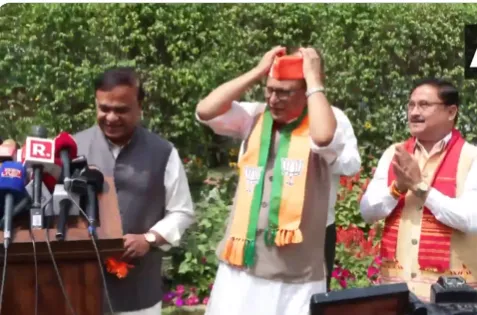
New Delhi, March 18: After resigning from the Congress party ahead of the Assam legislative assembly elections, MP Pradyut Bordoloi on Wednesday joined the Bhartiya Janata Party (BJP) in the presence of Assam Chief Minister Himanta Biswa Sarma and Assam BJP President Dilip Saikia.
Bordoloi, today, confirmed his acceptance when asked if he would join the BJP.
Pradyut Bordoloi has accused the party leadership of sidelining him, which led to the end of his lifelong association with the Congress party amid allegations of internal mistreatment.
He clarified that the resignation stemmed from "multiple issues" as opposed to a singular ticket allocation for the Assam Assembly elections.
"For me, getting a ticket was not a question of life and death. There were multiple issues. What was important for me was to hold my head high. The Congress party has given me a lot," he told the media.
"I want to make it very clear that I am in my second term in Lok Sabha, and there are another three years to go. I could have accepted the humiliation if I wanted to remain as an MP. But I decided to leave and work," he added.
Regarding the move, Navajyoti Talukdar, who also resigned as the Assam Pradesh Congress Committee (APCC) Vice-president yesterday, said that Bordoloi would join the BJP today.
"Today, our MP Pradyut Bordoloi is joining the BJP. The Chief Minister of Assam, Himanta Biswa Sarma, is a very dynamic leader. We have spoken to the Chief Minister of Assam," he said.
Following Bordoloi's resignation, Congress has fielded his son from the Margherita Assembly constituency for the upcoming Assembly polls.
Bordoloi's resignation comes a month after former Assam Congress chief Bhupen Kumar Borah joined the BJP, who served in the Congress for three decades.
Elections in Assam for all 126 Assembly constituencies will be held in a single phase on April 9, while the counting of votes is scheduled for May 4, the Election Commission of India announced on Sunday.
Assam will witness a fight between the incumbent BJP-led NDA government and Congress for the 126-seat assembly. The BJP government, led by Chief Minister Himanta Biswa Sarma, will look to secure a third consecutive term, while the Congress aims to defeat the ruling party to return to power. (ANI)