

.webp)

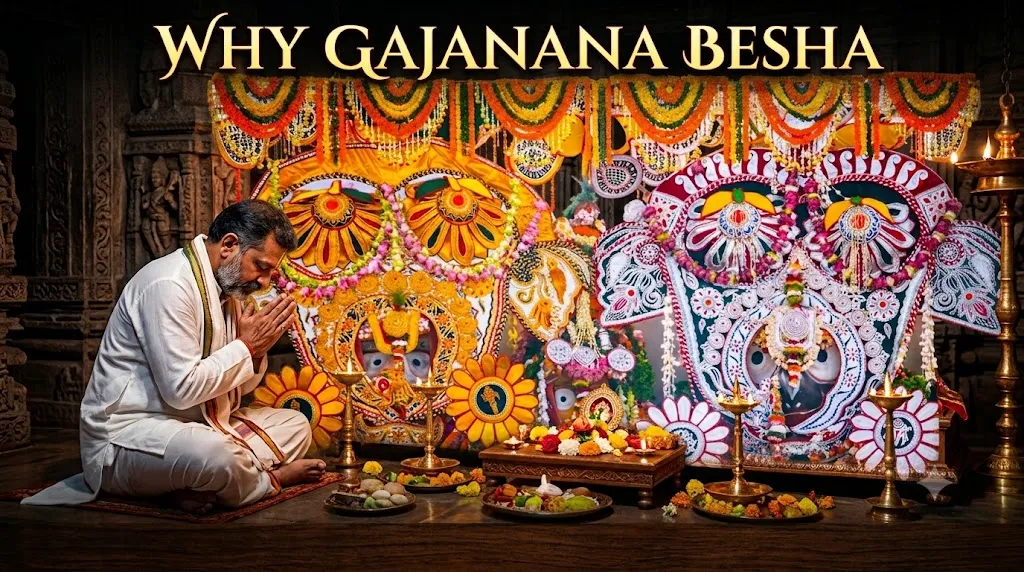
Among the countless mysteries surrounding Lord Jagannath, one of the most fascinating is the annual transformation of the Lord into Gajanana, the elephant-headed form. Every year on Snana Purnima, millions of devotees witness an extraordinary sight-the presiding deity of the Jagannath Temple no longer appears as Vishnu alone but assumes the divine form of various deities, reminding the world that Jagannath is not confined to a single faith, form or philosophy.
This unique ritual is more than a temple tradition. It is a profound spiritual declaration that Lord Jagannath embodies all deities, all sects and all paths of devotion.
The Lord of the Universe, Beyond Every Boundary
Lord Jagannath has always been regarded as one of the most mysterious deities in the world. Equally mysterious is his sacred abode-Sri mandir, Puri. For centuries, saints, philosophers, scholars, monks and pilgrims from across India have been drawn to this holy land in search of spiritual truth.
Researchers believe Jagannath's wooden idol symbolises the harmony of all religions and cultures. Every ritual associated with the Lord reflects human values, compassion, equality and inclusiveness, making Jagannath Culture one of India's most unique spiritual traditions.
Jagannath Represents the Five Principal Deities
Ancient Odisha has long followed the tradition of Pancha Devata Upasana—the worship of five principal deities:
· Lord Ganesha
· Lord Vishnu
· Lord Shiva
· Goddess Durga
· Lord Surya
Each deity has a sacred centre in Odisha:
Mahavinayak, Chandikhole – Ganesha Peetha
Jagannath Temple, Puri – Vishnu Peetha
Lingaraj Temple, Bhubaneswar – Shaiva Peetha
Biraja Temple, Jajpur – Shakti Peetha
Konark Sun Temple – Saura Peetha
Remarkably, Lord Jagannath is believed to encompass all these divine manifestations.
During different rituals throughout the year, He is worshipped in different forms:
Gajanana (Ganesha) during Snana Purnima
Vishnu on the Ratna Simhasana
Surya during Rath Yatra
Durga during Sayana Yatra
Rudra (Shiva) during Nabakalebara
This unique philosophy makes Jagannath the living symbol of religious unity.
The Devotee Who Changed Temple Tradition Forever
Behind the famous Gajanana Besha lies a remarkable story of devotion.
Centuries ago, a devout Ganesh worshipper named Ganapati Bhatta travelled from Maharashtra to Puri solely to seek Lord Jagannath's blessings. Since he worshipped Lord Ganesha day and night, he longed to see Jagannath in the form of his beloved deity.
However, after entering the sanctum, he found Jagannath seated in his usual divine form. Heartbroken that his wish remained unfulfilled, Ganapati Bhatta left Puri in disappointment.
That night, Lord Jagannath appeared in his dream.
The Lord instructed him to return to the temple the next morning.
When Ganapati Bhatta came back, an astonishing miracle awaited him.
There, upon the Ratna Simhasana, stood Lord Jagannath in the majestic form of Gajanana.
Overwhelmed with emotion, the devotee realised that Jagannath accepts every form of sincere devotion and reveals Himself according to the faith of His devotees.
It is believed that this divine episode eventually gave rise to the annual Gajanana Besha observed on Snana Purnima.
More than an elephant form
Scholars point out an interesting linguistic symbolism.
The word "Gaja" is hidden within "Jagannath." When the syllables are rearranged, "Jag" transforms into "Gaj," symbolising that both ultimately represent the Supreme Brahman.
Just as Ganesha is Ganapati, the Lord of all beings, Jagannath is Jagannath, the Lord of the Universe.
The message is unmistakable-there is no separation between the divine forms.
The Intricate Art Behind the Gajanana Besha
The preparation of the Gajanana Besha is itself a masterpiece of traditional craftsmanship.
Temple artisans carefully prepare the attire using:
White and black velvet
Silk fabric
Zari embroidery
Shola pith
Banana fibre
Wood apple gum
Other traditional natural materials
Once the attire is completed, it is sanctified with camphor before being offered to the deities.
During the ritual:
Lord Balabhadra appears in a white Gajanana form.
Lord Jagannath appears in a black Gajanana form.
The breathtaking sight attracts lakhs of devotees every year.
Interestingly, several historians note that ancient scriptures such as the Padma Purana, Brahma Purana, Skanda Purana and Vamadeva Samhita do not explicitly mention the Gajanana Besha.
Many scholars therefore believe that the ritual gained prominence around the 17th century, inspired by the devotion of Ganapati Bhatta.
Some temple scholars also interpret the three deities during Snana Purnima as symbolic manifestations of different forms of Ganapati worship.
Sri Khetra has welcomed saints of every faith-Kabir, Guru Nanak, Chaitanya Mahaprabhu, Tulsidas, Manohar Das and countless others.
Each experienced Lord Jagannath differently.
Each discovered a new dimension of the same Supreme Being.
The annual Gajanana Besha is perhaps the finest expression of this universal philosophy-that God is not limited by names, forms or traditions.
For millions of devotees, Lord Jagannath is not merely Vishnu, Krishna or Ganesha.
He is everything.
And on Snana Purnima, when the Lord smiles through the face of Gajanana, he reminds humanity that every path of sincere devotion ultimately leads to the same divine destination.
.webp)