

.webp)

Puri, Jul 10: Among the many unique rituals associated with Lord Jagannath of Puri, the offering of ‘Bidia Paan’-a specially prepared ‘paan’-remains one of the most fascinating traditions preserved inside the 12th-century shrine.
According to temple lore, Lord Jagannath is offered betel leaves after his meals as part of the daily mukhashringara (post-meal adornment ritual). Every day, 104 specially prepared betel leaves are offered to the deities, a service that has been carried out for generations by dedicated temple servitors.
The preparation of these sacred betel leaves takes place inside the temple's Bidia Ghara, a designated chamber where specially appointed servitors prepare the offerings. Unlike ordinary betel leaves, Jagannath's Bidia Paan contains areca nut, cardamom, cloves, saffron and sandalwood, but no lime or catechu, making it unique to the temple tradition.
The Legend of Chakei Das
Temple tradition attributes the origin of this sacred service to Chakei Das, a saint believed to have arrived in Puri from South India. Filled with devotion, he wished to spend the rest of his life in the holy city, living on Lord Jagannath's Mahaprasad. However, as his savings gradually ran out, he became anxious about sustaining himself.
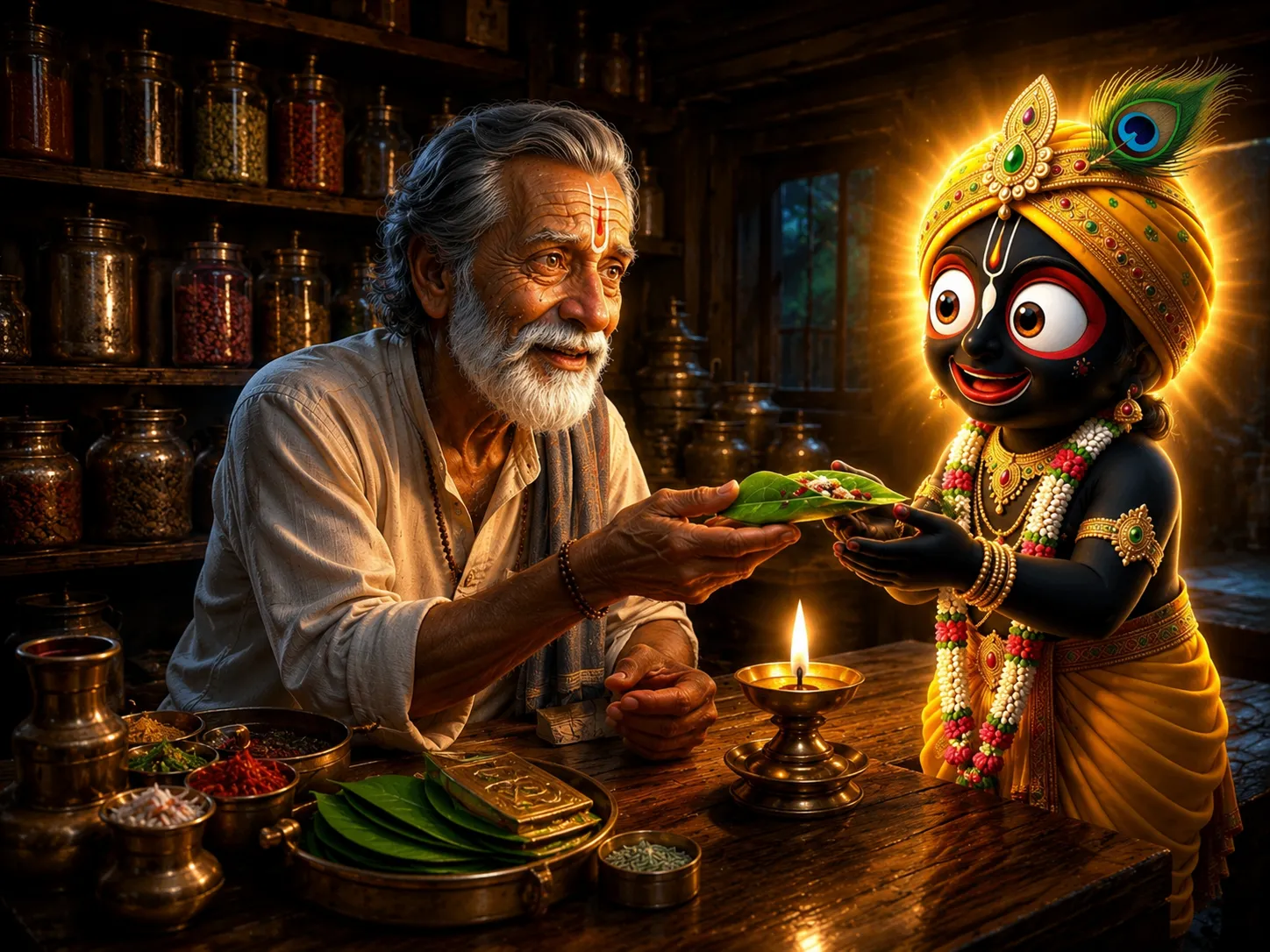
The legend says that Lord Jagannath appeared to him in a dream and instructed him to start selling betel leaves near the Singhadwara (Lion's Gate) of the temple. Following the divine command, Chakei Das opened a small paan stall, using the earnings from his business to purchase Mahaprasad and continue his life of devotion.
One day, according to the legend, Lord Jagannath and his elder brother Lord Balabhadra arrived at the stall disguised as two young boys. They requested specially prepared betel leaves containing sandalwood, cloves and cardamom.
Initially reluctant to serve children, Chakei Das eventually prepared the paan for them. After enjoying it, the boys promised that their father would settle the payment later. This unusual routine continued for nearly two months as the mysterious boys repeatedly enjoyed the paan but never paid.
Growing impatient, Chakei Das finally refused to serve the boys unless they cleared their dues or left something valuable as security. Smiling, one of the boys handed over a cloth before taking the paan.
Later that day, during preparations for the temple's midday offering, priests reportedly discovered that Lord Jagannath's sacred Gitagovinda Khandua Pata-the ceremonial silk cloth adorning the deity-was missing. The absence of the cloth prevented the ritual from proceeding, prompting concern among the temple servitors.
The matter soon reached the Gajapati Maharaja, the traditional first servitor of Lord Jagannath. As the king arrived at the temple, Chakei Das stopped his procession, believing him to be the father of the two boys who owed him money.
When questioned, Chakei Das described the boys as one dark-complexioned and the other fair, both wearing sacred threads. He then produced the cloth they had left as security. The king immediately recognised it as the Lord's sacred Gitagovinda Khandua Pata.
Overwhelmed with emotion, the Gajapati is believed to have realised that the two boys were none other than Lord Jagannath and Lord Balabhadra themselves. He bowed before Chakei Das, declaring him blessed for serving the Lord directly.
Moved by Chakei Das's devotion, the king arranged a permanent residence for him near the temple. As the devotee prepared paan beneath a large ceremonial umbrella, the place later became known as Bada Chhata Math.
According to temple tradition, Chakei Das and later his descendants continued preparing the Lord's sacred Bidia Paan, a hereditary service that survives to this day.
Even today, two varieties of Bidia Paan—Chauta Bidia and Khili Bidia—are prepared daily for Lord Jagannath. The betel leaves are carefully folded and filled with areca nut, cardamom, saffron and cloves, but unlike ordinary paan, no lime or catechu is added.
This distinctive preparation remains an integral part of the Lord's daily rituals, symbolising devotion, purity and the intimate relationship between the deity and His devotees.
While historians regard the story of Chakei Das as part of Jagannath temple's rich oral tradition rather than a historically verified event, the legend continues to inspire millions of devotees and remains deeply woven into the spiritual heritage of Puri.
.webp)