



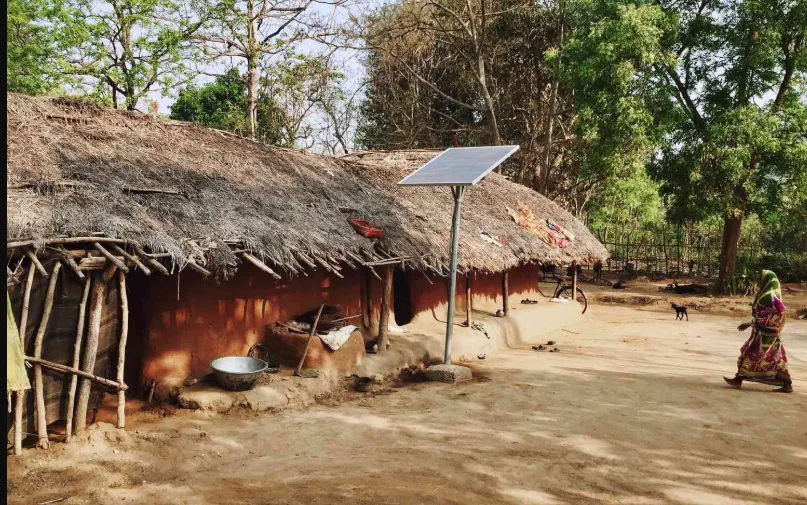
Bhubaneswar, Oct 5: Once upon a time, the very mention of a village brought to mind a picture of lush greenery, peaceful surroundings and rows of traditional thatched houses with mud walls and straw roofs.
These humble homes were more than just shelters. Their thatched roofs kept the interiors naturally cool during the scorching summer months and warm during winter. They were also a living symbol of rural culture, community life and the spirit of togetherness.
But times have changed. In today’s modern rural landscape, traditional thatched houses are becoming increasingly rare. With straw and bamboo becoming difficult to procure, people are gradually replacing these homes with concrete structures.
Traditional thatched houses were completely environment-friendly. While concrete houses offer greater safety and durability, they lack the natural cooling provided by thatched roofs. Over the years, improving economic conditions, the successful implementation of housing schemes and the need for protection from natural disasters have encouraged rural families to embrace concrete houses.
Frequent cyclones, heavy rainfall and the risk of fire have also made pucca houses a necessity for many families seeking greater safety and an improved standard of living.
The traditional craftsmen who once specialised in thatching roofs are also disappearing with time. The declining number of cattle in villages has made cow dung, traditionally used for plastering and maintaining mud floors and walls, increasingly difficult to obtain.
According to Gundicha Maharana, a traditional thatching craftsman from the Pipili area, thatched houses were once built in a variety of designs. Wealthier families often preferred Khanja houses, which were designed with a courtyard in the middle. Others built Dandi houses, while intricate artistic designs were carved into wooden structures.
These traditional homes were not only aesthetically beautiful but were also remarkably resilient. Their construction made them difficult to damage during natural calamities.
Today, however, such houses are rarely constructed. In a few places, thatched structures are still built as small shelters or cattle sheds, but the traditional art of building thatched homes is steadily fading away.
Before the devastating 1999 Super Cyclone, thatched houses were common across rural Odisha. The cyclone changed the way many people viewed such homes. Having witnessed the destruction caused by the disaster, many families became reluctant to continue living in thatched houses.
The expansion of housing schemes has further accelerated this transition. With more rural families receiving concrete houses, the traditional thatched home is gradually disappearing from the village landscape.
What was once an inseparable part of rural Odisha’s identity is now becoming a fading memory — preserved mainly in the stories of older generations and the skills of a dwindling number of traditional craftsmen.