


Every year, during Rath Yatra in Puri, millions of devotees watch in awe as Lord Jagannath, Lord Balabhadra and Devi Subhadra are visitng to their aunt’s home.
Yet, amid all the rituals, one timeless mystery continues to fascinate devotees.
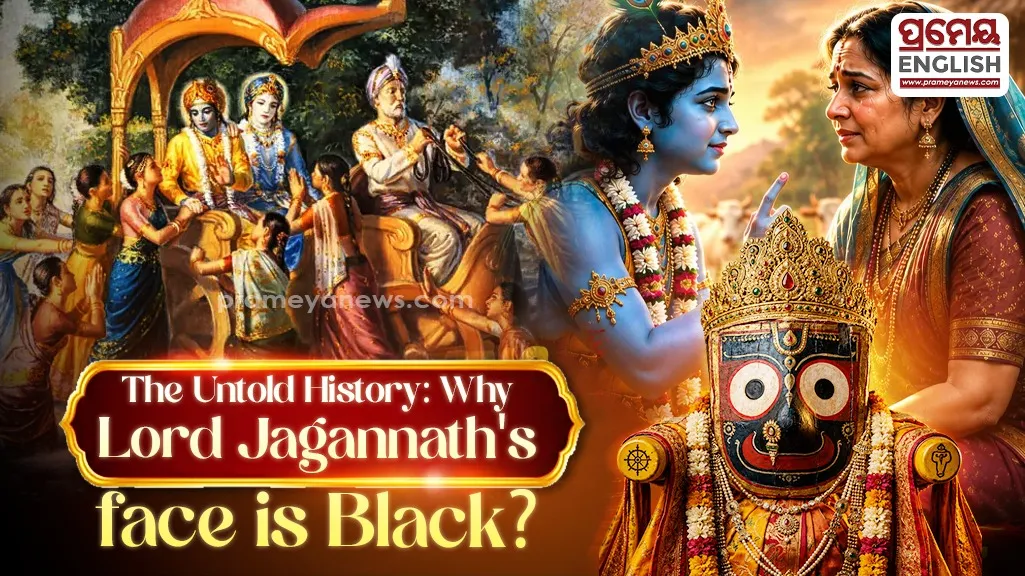
Why is Lord Jagannath's face jet black?
While scholars explain the iconography of Jagannath through various religious and historical perspectives, Odisha's oral tradition preserves a deeply emotional legend-one that is rarely found in scriptures but has been passed down through generations of devotees. It is a story not of divinity alone, but of a son's love, regret, and an eternal promise to his mother.
A Promise That Was Never Kept
Long before he became Jagannath, the Lord descended to earth as Lord Krishna in Dwapara Yuga.
Born to Devaki but raised by Mother Yashoda in Gokul, Krishna filled the lives of the people around him with joy. His playful childhood, divine miracles, and boundless affection turned him into the heartbeat of Gokul. The Gopis adored him, his friends worshipped him, and Yashoda saw him as her entire world.
Then came the day destiny called.
Krishna had to leave for Mathura to end the tyranny of King Kansa.
Before departing, he comforted his grieving mother.
"Mother, this is only a short journey. I shall return soon."
Trusting her beloved son, Yashoda let him go.
But Krishna never returned to Gokul.
The waiting that never ended-days became months and months became years.
Every morning the people of Gokul looked towards the road leading to Mathura, hoping to catch a glimpse of Krishna.
The Gopis wept.Radharani lived in endless separation. Yashoda waited silently.
As hope faded, questions turned into accusations.
The villagers began asking Yashoda,
"When will your son return?"
Soon sympathy gave way to resentment.
People blamed Krishna for stealing everyone's hearts before abandoning them forever.
And Yashoda, despite knowing her son's divine mission, had no answers.
The pain of those words slowly consumed her.
According to the ancient folk belief, her radiant face darkened under the weight of sorrow and humiliation.
The Day Krishna Returned
Much later, after slaying Kansa and fulfilling his mission, Krishna returned to meet his mother.
The first thing he noticed was not her smile-but the sadness written across her face.
"Mother, why do you look so grief-stricken?" He asked.
Yashoda replied,
"After you left, everyone blamed me. They called you faithless. They mocked me because you never came back. My face has turned dark with shame because of the pain your absence caused."
Those words pierced Krishna's heart.
A Divine Promise for the Ages
Unable to bear the thought that his mother had suffered because of him, Krishna made an extraordinary promise.
"Mother, in this age, your face has darkened because of me.
But in Kali Yuga, when I appear as Lord Jagannath, I shall bear that darkness myself.
My face alone will remain black, so the world will know that the sorrow was mine to carry—not yours."
Devotees believe Krishna fulfilled that promise when he manifested as Lord Jagannath in Puri.
That, they say, is why the Lord's face is deep black-an eternal reminder of a son's love for his mother.
To millions of devotees, Jagannath's dark face is not merely an artistic expression or a feature of the wooden idol.
It is compassion, sacrifice and repentance.
It is a divine reminder that the Lord willingly accepts the pain of those he loves.
Perhaps that is why devotees affectionately call Him Kalia Saanta-the dark Lord who carries the grief of the world with an ever-smiling face.
This touching legend is not found in the canonical scriptures of Jagannath worship. Instead, it survives through Odisha's rich oral tradition—shared by temple servitors, storytellers, elders, and devotees across generations.
Whether one views it as folklore or faith, the story continues to inspire millions because it reflects the essence of Jagannath Himself-a God who is not distant or inaccessible, but deeply human in his emotions, bound by love, family, and compassion.
As devotees gather every year to witness the Lord's sacred bath during Snana Yatra, many fold their hands before that mysterious black face with renewed emotion.
For them, it is not merely the face of God.
It is the face of a son who chose to bear the burden of his mother's sorrow for eternity.