


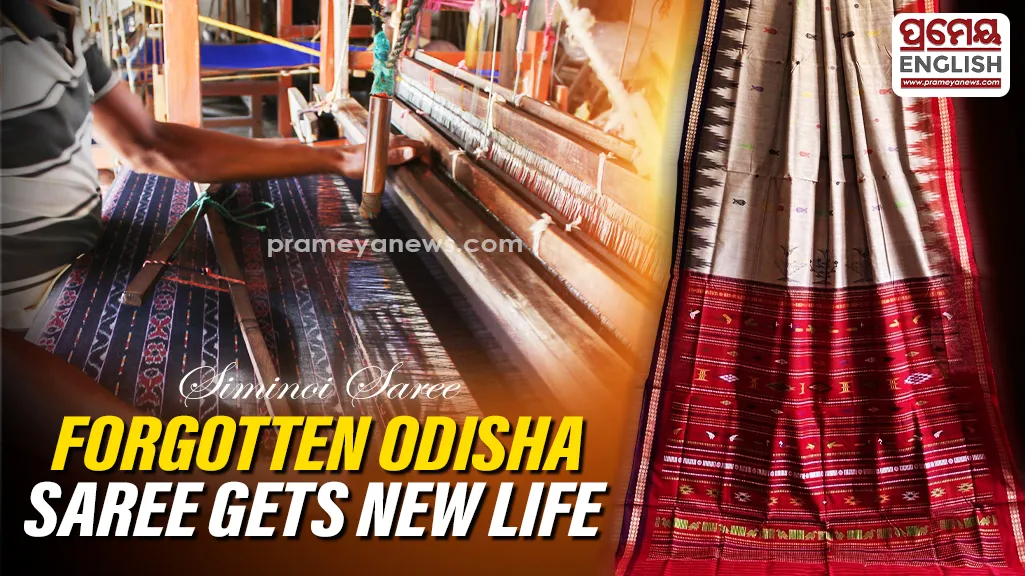
Dhenkanal, Sept 28: For generations, the name of Siminoi village in Dhenkanal district was closely associated with its distinctive handloom sarees. But today, the Siminoi handloom saree exists largely in memory, with weaving having stopped for nearly five decades.
Although the saree is recognised in the handloom tradition, there are hardly any original pieces left to showcase to the next generation. Only one or two elderly weavers still know the traditional weaving technique, while most artisans in the village now depend on powerlooms.
However, after decades of decline, efforts are now underway to revive the traditional Siminoi handloom saree. The government has started training local weavers to return to handloom weaving and preserve the craft.
Once a Wedding Essential
According to weaver Pradip Kumar Singh, Siminoi sarees once enjoyed considerable popularity. Almost every family in the village was involved in weaving them.
During the princely-state era, the sarees were particularly sought after and were considered essential for occasions such as weddings and traditional ceremonies. At the time, a saree reportedly cost around Rs 2 to Rs 3, while demand in the market remained strong.
How Powerlooms Changed Siminoi’s Weaving Tradition
The decline began after powerloom machines were introduced in Siminoi in 1971. Weavers were encouraged to shift to machines with the promise of higher production, increased sales and better income.
As more artisans moved from handlooms to powerlooms, traditional handwoven Siminoi sarees gradually disappeared. Over time, the knowledge of weaving the original saree was also lost as the technique was no longer passed down from one generation to another.
Today, only a single original copy of the traditional saree is reportedly preserved by a weaver. He had earlier refused to hand it over to the government, saying it was a valuable symbol for his future generations.
Unique Design, Soft Yarn
The traditional Siminoi saree was woven using 22/26 and 34/32-count yarn. Its border featured a distinctive Siminoi design, while the body carried motifs depicting fish, elephants and various animals and birds.
The saree's biggest speciality was its exceptionally soft yarn. According to local weavers, the fabric was so light and comfortable that it almost felt weightless when worn.
Government Push to Bring It Back
Textile Inspector Prashant Kumar Sahu said efforts are underway to revive the traditional Siminei saree.
Some local weavers are currently being trained to use handlooms instead of powerlooms, with the aim of restoring the traditional weaving technique and bringing the saree back to the market.
After remaining absent from the weaving scene for nearly 50 years, Siminei’s iconic handloom saree may soon return,not merely as a piece of fabric, but as a living symbol of the village’s weaving heritage.