



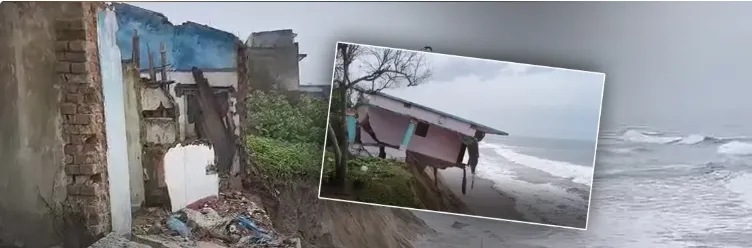
Berhampur, Jul 4: The relentless advance of the sea has erased the last remaining traces of the abandoned village of Podampeta in Odisha's Ganjam district. On Friday, the rough sea engulfed the village's final three deserted houses, marking the complete disappearance of the settlement under the impact of severe coastal erosion.
Powerful waves breached the shoreline and advanced into the village, reaching close to an unused cyclone shelter. Following the destruction of the last houses, the district administration sealed the road leading to the abandoned village by digging trenches and erecting "No Entry" signboards to prevent people from entering the danger zone.
The sea has turned increasingly turbulent due to active monsoon conditions triggered by a low-pressure system and the effects of climate change. High tides from the Bay of Bengal have intensified coastal erosion, swallowing not only the remaining houses but also hundreds of acres of cashew and casuarina plantations. Citing safety concerns, the administration has prohibited public access to the abandoned village.
The sealing operation was carried out in the presence of Tahsildar Sukanta Chandra Mishra, BDO Achyutananda Jani, Humma outpost officer Binayak Das, RI Sitaram Sahu and Amin Lalakrishna Das.
The threat, however, extends beyond Podampeta. Residents of nearby villages are also witnessing seawater entering their localities during high tides. Kantiagada village is now considered highly vulnerable, leaving villagers gripped by fear over the possibility of further coastal inundation.
Concerned over the worsening situation, Chhatrapur MLA Krushna Chandra Nayak requested Ganjam Collector V. Keerthi Vasan to hold discussions with affected residents. Acting on the request, the Collector convened a meeting on Friday with residents of Kantiagada, Khatuakuda and Niladripur villages to hear their grievances and assured them that remedial measures would be taken. The MLA was also present during the meeting.
Former sarpanch Dillip Chhotaray warned that unless immediate intervention is undertaken, seawater could soon inundate Kantiagada and other nearby villages. He urged the administration to undertake sand management at the river mouth and implement protective measures within the next two days to prevent further damage.
The Collector has directed a team led by the Chhatrapur Sub-Collector, along with officials from the Irrigation Department, to inspect the affected area and submit a detailed report. He noted that the issue of the silted river mouth falls under the Coastal Regulation Zone (CRZ) framework.
The Rushikulya river mouth, where the Bay of Bengal meets the river, is internationally known as a nesting and migratory habitat for the endangered Olive Ridley sea turtles. Consequently, any engineering or restoration work in the area will require prior approval from the Forest and Environment Department.
Officials explained that the course of the Rushikulya river mouth has shifted over time. Earlier, it was aligned near the Rushikulya bridge, allowing tidal waters to flow naturally between the sea and the river without causing significant land erosion. However, the formation of a new river mouth near Podampeta has resulted in stronger tidal currents striking the coastline directly, accelerating shoreline erosion and putting more coastal villages at risk.