
.webp)

New Delhi, August 18:The Supreme Court on Tuesday said it would constitute a high-powered committee headed by a former Supreme Court judge to examine allegations of police excesses against student protesters and other issues arising from demonstrations over alleged NEET and other examination paper leaks.
A bench headed by Chief Justice of India Surya Kant and comprising Justices Joymalya Bagchi and V. Mohana said the proposed panel would also include a former High Court judge and a retired Director General of Police.
The Chief Justice said the consent of a former CBI Director and a former DGP, neither of whom belongs to any of the States involved in the matter, had been obtained. The court said it would pass a formal order after considering all aspects concerning the constitution and functioning of the committee.
The bench allowed the parties to submit written suggestions on the proposed panel's mandate and scope. It said an order setting out the committee's framework would be issued on Wednesday, after which the panel could begin its work.
The committee is expected to examine a wide range of issues arising from student protests held at different locations across the country over alleged examination paper leaks. These include allegations of police excesses, violence against security personnel and sexual harassment of women protesters.
The court also indicated that the panel would not necessarily have to wait for the completion of its entire inquiry before bringing urgent matters to its attention. It said the committee could submit interim reports on issues requiring immediate consideration.
At the same time, the Supreme Court made it clear that certain constitutional and legal questions would remain within its exclusive jurisdiction. The bench said issues involving facial-recognition technology, surveillance, privacy and the fundamental right to life and personal liberty under Article 21 of the Constitution would ultimately have to be adjudicated by the apex court.
The Supreme Court also expressed its intention to examine the possibility of quashing FIRs registered against student protesters in connection with demonstrations over examination paper leaks.
The court directed States to identify FIRs registered against students and protesters in cases where no other serious criminal elements were involved. The bench indicated that it could consider exercising its extraordinary powers under Article 142 of the Constitution to quash such cases, while making it clear that matters involving individuals with serious criminal antecedents could be dealt with separately.
Emphasising the potential impact of criminal proceedings on young students, the bench observed that the issue concerned "the life and future of innocent students".
The Supreme Court was hearing a batch of petitions alleging excessive police action against students who participated in protests at Jantar Mantar and other locations across the country over alleged NEET paper leaks and wider concerns regarding the examination system.
The proceedings come against the backdrop of weeks of student demonstrations led by the Cockroach Janata Party (CJP) at Jantar Mantar, including a hunger strike and a subsequent march towards Parliament.
On July 20, thousands of students took part in a Parliament march organised by the CJP, demanding, among other things, the resignation of Union Education Minister Dharmendra Pradhan over alleged examination paper leaks and seeking broader reforms in the examination system.
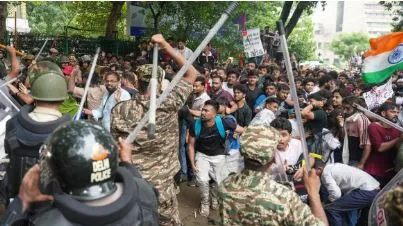
As protesters attempted to move towards Parliament and breach police barricades in central Delhi, security personnel used tear gas and lathi-charge to disperse the crowd. Several videos later circulated on social media, purportedly showing protesters being manhandled by police personnel and prompting allegations of excessive use of force.
The Delhi Police, however, defended its action, maintaining that force was used only after sections of the protesting crowd allegedly turned violent and engaged in stone-pelting.
The proposed high-powered committee is expected to provide an independent examination of the allegations and the circumstances surrounding the protests. The Supreme Court is likely to finalise the panel's mandate and framework in its order on Wednesday after considering suggestions from the parties.
.webp)