
.webp)



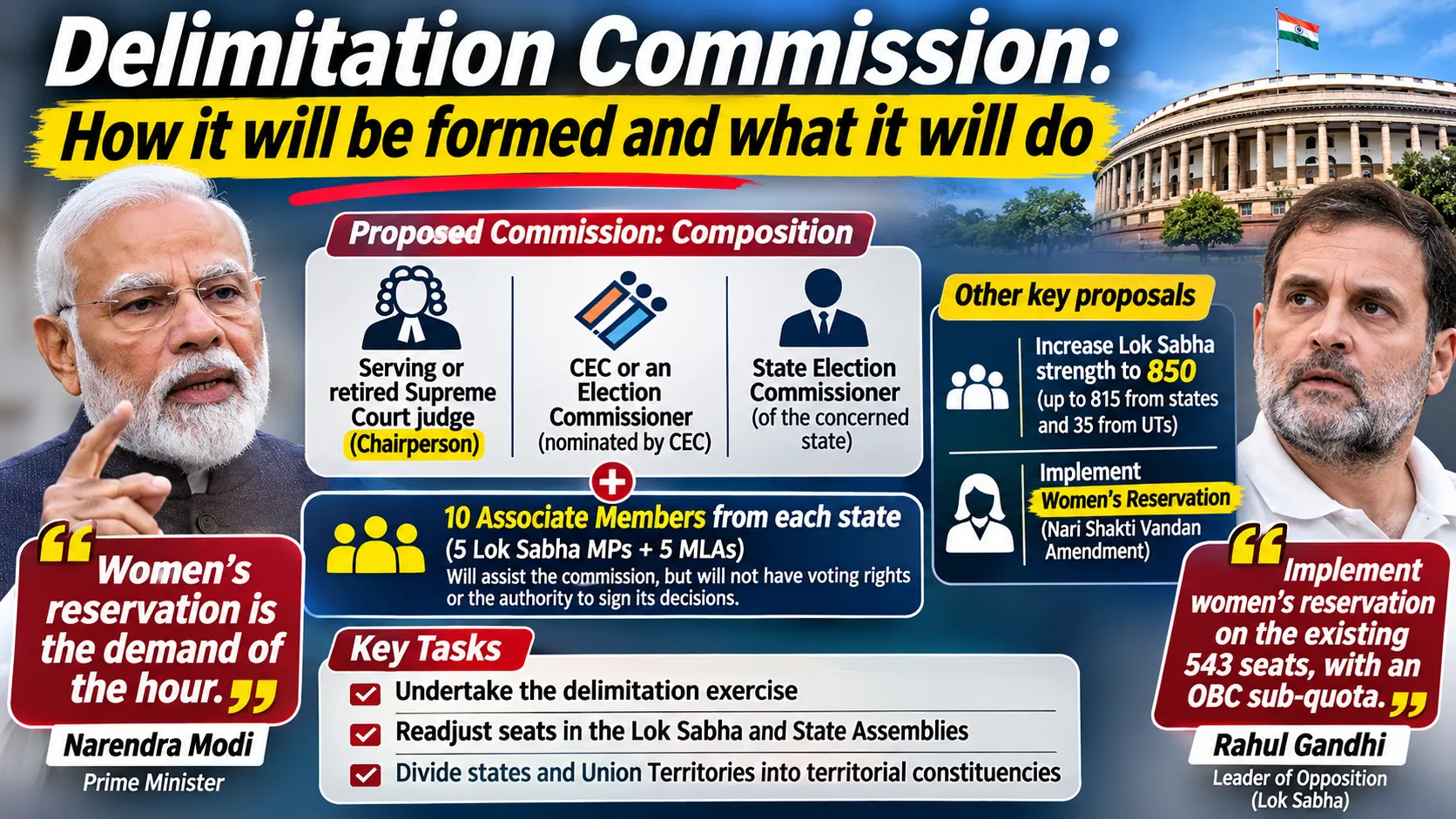
New Delhi, November 29: The proposed Delimitation Commission will be headed by a serving or retired Supreme Court judge and will include the Chief Election Commissioner (CEC) or an Election Commissioner nominated by the CEC, along with the State Election Commissioner of the state concerned, according to the proposed provisions. The Chairperson will be appointed by the Central Government, while the other two members will serve in their official capacities.
The three-member commission will be assisted by 10 associate members from each state. These will comprise five Lok Sabha MPs representing the state and five members of its Legislative Assembly. The Speaker of the Lok Sabha will nominate the five MPs, while the Speaker of the respective State Legislative Assembly will nominate the five MLAs.
The associate members will assist the commission in its work but will not have voting rights or the authority to sign its decisions. In states with five or fewer Lok Sabha MPs, all such MPs will be included, with the number of associate members reduced accordingly.
Also read: Odisha CM Majhi highlights PM Modi’s message to youth after listening to 140th ‘Mann Ki Baat’
The proposed commission will be responsible for readjusting seats in the Lok Sabha and State Legislative Assemblies, as well as dividing states and Union Territories into territorial constituencies. These provisions will take effect only if the Delimitation Bill is passed by Parliament and receives the President's assent.
Meanwhile, Prime Minister Narendra Modi on Sunday reiterated the government's commitment to women's reservation, describing the proposed Nari Shakti Vandan Amendment as the “demand of the hour”.
In a video message shared on X, Modi said efforts to ensure greater participation of women in the country's political system had continued for decades. He said the BJP-led NDA remained committed to fulfilling its promise of women's empowerment.
The Prime Minister also stressed that national interest should take precedence over political considerations, arguing that women's empowerment and the country's interests suffer when party interests are placed above them.
The proposed legislative package comprises the Constitution (132nd Amendment) Bill, 2026, the Delimitation (Second) Bill, 2026, and the Union Territories Laws (Amendment) Second Bill, 2026.
The proposals seek to increase the maximum strength of the Lok Sabha from 543 to 850 members, with up to 815 representatives from states and 35 from Union Territories.
The debate over expanding Parliament has also brought back earlier arguments in favour of increasing the strength of the Lok Sabha. In December 2019, former President Pranab Mukherjee had argued that the number of seats should be increased, citing the growth in India's population and the rising number of voters represented by each MP. He had suggested expanding the Lok Sabha to 1,000 members and increasing the strength of the Rajya Sabha as well.
The government's efforts to secure the two-thirds majority required for the constitutional amendment have received support from the Dravida Munnetra Kazhagam (DMK), Yuvajana Sramika Rythu Congress Party (YSRCP) and Nationalist Congress Party-Sharadchandra Pawar (NCP-SP), according to the report. Their backing is estimated to take the NDA's tally in the Lok Sabha to around 354 MPs.
The DMK, which has 22 Lok Sabha MPs, has supported the proposed 50 per cent expansion in parliamentary seats while insisting that Tamil Nadu's existing share of representation be protected. The YSRCP has also reiterated its support, while the NCP-SP has indicated backing for the revised proposals.
Opposition parties, however, have raised concerns over linking women's reservation with delimitation and have called for the exercise to be based on the latest Census data. Leader of Opposition Rahul Gandhi has demanded that women's reservation be implemented within the existing 543 Lok Sabha seats, along with an OBC sub-quota. He has opposed increasing the strength of the House to 850 and called for delimitation to be conducted using the 2027 Census.
Congress president Mallikarjun Kharge has also questioned the proposed exercise, raising concerns over its possible implications for the representation of Scheduled Castes and Scheduled Tribes. (With ANI inputs)
.webp)