


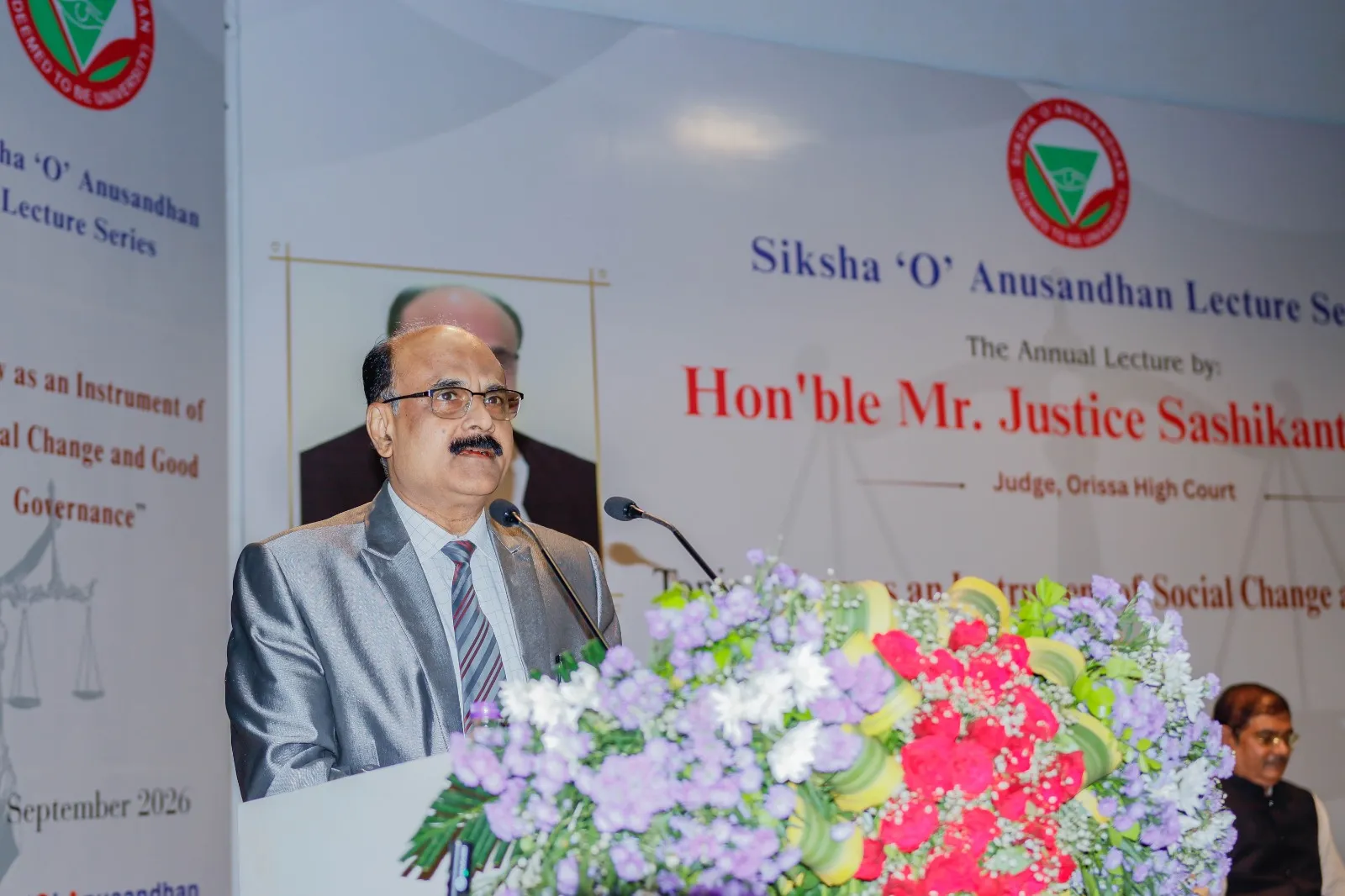
Bhubaneswar, Sept. 26: The evolution of India’s legal system over the years has brought about significant social changes and triggered transformation across various fields, Justice Sashikanta Mishra, Judge of the High Court of Orissa, Cuttack, said on Saturday.
“The law operates as an engine of change. When the law acts, society follows,” Justice Mishra said while delivering a lecture on ‘Law as an Instrument of Social Change and Good Governance’ at the SOA Deemed to be University here.
The lecture was organised as part of the SOA Lecture Series and was attended by students of legal studies and agriculture, along with faculty members. SOA Vice-Chancellor Prof. Pradipta Kumar Nanda presided over the programme.
Prof. S.A.K. Azad, Dean of the SOA National Institute of Law (SNIL), introduced the speaker, while Prof. Jyoti Ranjan Das, Dean (Students’ Welfare), proposed the vote of thanks.
Law and Social Transformation
Justice Mishra said that during the pre-Constitution era, Indian society was deeply divided by the practice of untouchability. People branded as “untouchables” were prohibited from entering temples, while there was no clear legal framework to address the discriminatory practice.
Article 17 of the Constitution abolished untouchability and established equality among citizens, he said. Judicial interventions in various areas over the years had subsequently brought about several significant changes in society.
Referring to legal interventions concerning road safety, Justice Mishra said that wearing helmets while riding two-wheelers and using seat belts while travelling in cars had become mandatory through legal measures.
He noted that cars in earlier years did not necessarily have seat belts, whereas today vehicle manufacturers are required to provide them and drivers can face penalties for not wearing them.
Justice Mishra also referred to the ban on smoking in public places as another important legal intervention. He said the measure had significantly changed public behaviour, with designated areas being provided for smokers in places where permitted.
Law as an Instrument of Reform
Listing several other transformations brought about through legislation and judicial intervention, Justice Mishra referred to the Right to Information Act, recognition of the third gender, and reservation policies aimed at bringing disadvantaged sections of society into the mainstream.
Speaking about the social evil of dowry, he said it had its roots in a chauvinistic mindset in which the groom’s family considered accepting the bride into their household a favour that required compensation. The law, he said, had taken a serious and stringent position against the practice.
“We must thank the law for abolishing a cruel act like ‘sati’, while a progressive idea like widow remarriage had been made legal and an evil like child marriage removed through the law,” Justice Mishra said.
He described Article 21 of the Constitution, which guarantees the right to life and personal liberty, as the “soul of the Constitution.”
Justice Mishra also referred to the landmark 1997 Supreme Court judgment in the Vishaka case, which laid down legally binding guidelines to prevent sexual harassment at the workplace and strengthen safeguards for women.
Law and Good Governance
Justice Mishra said good governance involved ensuring compliance with the law, accountability and transparency, as well as enabling people’s participation in the democratic process.
He also stressed the need for strong measures to combat corruption, referring to the Prevention of Corruption Act as an important legal instrument in this regard.
“Most of the matters which are placed before me as a judge of the High Court pertain to pleas seeking action to address a problem,” he said, adding that the judiciary played an important role in ensuring good governance.
Message to Agriculture Students
Addressing the students of agriculture, Justice Mishra urged them to understand the realities of farming and to “start thinking like a farmer”, pointing out that a large section of India’s population depends on agriculture for its livelihood.
“You should know how the law operates and should have an open mind,” he said, adding, “The human mind is like a parachute which works when it is open.”