
.webp)

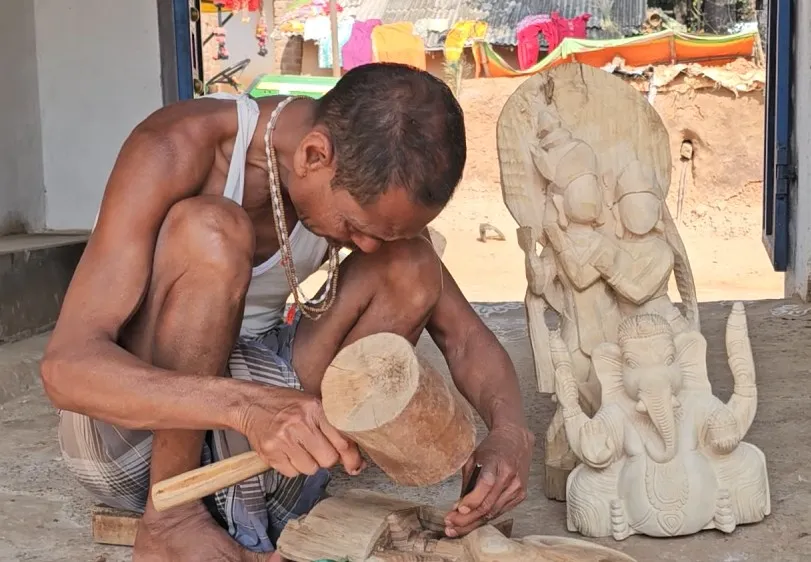
Koraput, June 26: A group of artisans from Girla village under Kotpad block in Odisha's Koraput district has transformed traditional craftsmanship into a sustainable source of livelihood by producing exquisite wood, iron and bamboo handicrafts. While their products have earned appreciation at exhibitions across the state, the artisans say the lack of permanent marketing facilities is limiting their income.
The journey began in 2006 when a group of men from Girla formed the Vishwakarma Self-Help Group (SHG). With financial assistance through a bank loan and support from the then Koraput Collector, Shubha Sharma, the artisans underwent specialised woodcraft training.
After completing the training, they began creating intricately carved wooden idols of Lord Ganesha, Lord Krishna, Lord Jagannath, peacocks and traditional tribal figures. They also expanded into bamboo handicrafts, producing decorative items such as bows and arrows, bamboo sticks and various home décor products. In addition, the artisans developed expertise in crafting iron sculptures depicting Hindu deities, animals, birds and tribal life.

Inspired by the success of the men, women of the village decided to contribute to the family's income. Three years ago, 20 women came together to form the Woodcraft Producer Group under Mission Shakti.
With a loan of ₹2 lakh provided through Mission Shakti, the women purchased woodcraft machinery and other essential equipment before receiving specialised training from an expert from Kolkata. They now manufacture a wide range of handcrafted fashion accessories, including earrings, bangles, necklaces, hair clips and decorative jewellery made from wood.
Today, both the men's and women's groups regularly participate in major exhibitions and fairs such as Koraput Parab, Malyabanta Festival in Malkangiri, Chaiti Festival in Rayagada and the Adivasi Mela in Bhubaneswar, where they showcase and sell their handcrafted products.
The wooden sculptures are priced between ₹3,000 and ₹10,000, while the handcrafted jewellery and decorative items have also found a steady market among visitors. The earnings have helped many women become financially independent and contribute to their household income.

Despite their success, the artisans say they remain largely unknown outside exhibition circuits. Since they get opportunities to sell their products only during fairs and festivals, business remains seasonal. They believe that better publicity and a permanent sales outlet would significantly improve their income.
The artisans have appealed to the state government to establish a permanent handicrafts showroom or sales kiosk in Kotpad town so that tourists and local buyers can access their products throughout the year. They say such support would not only improve their livelihoods but also help preserve and promote the region's rich traditional craftsmanship for future generations.
.webp)