

.webp)



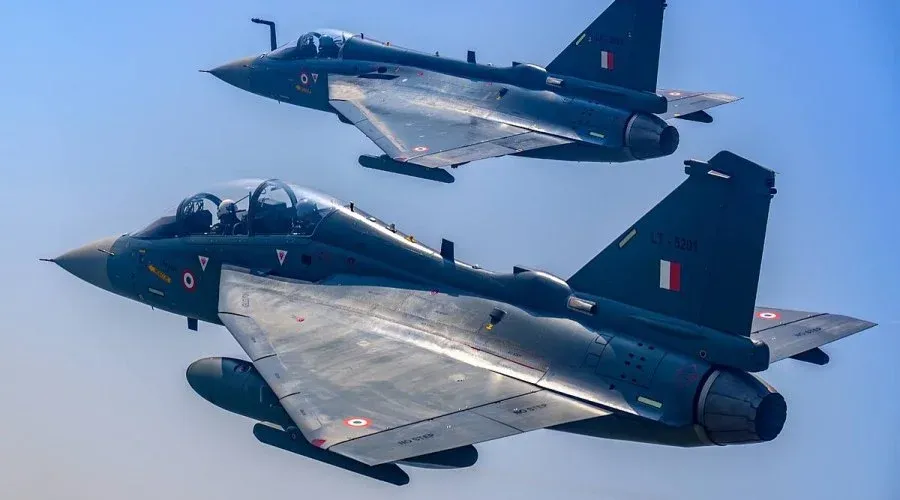
Upgraded Tejas Mk1A brings sharper radar and electronic combat tools.
India's air defence fleet is set to gain sharper combat claws as the Indian Air Force (IAF) prepares to induct its first indigenous Tejas Mk1A squadron by March 2027. Manufactured by Hindustan Aeronautics Limited (HAL), this upgraded fighter replaces older systems with stronger threat detection, electronic shielding, and digital flight controls. Deliveries for the initial batch of 83 jets were originally slated for March 2024, though supply delays involving US-made GE Aerospace F404 engines pushed induction to 2027. New Delhi signed its first contract for 83 fighters in February 2021 and added a second order for 97 aircraft in September 2025, bringing total commitments to 180 jets. Strengthening domestic fighter production carries strategic urgency for India as the air force works to offset shrinking squadron numbers and retire ageing aircraft.
Sharper eyes with electronic radar
Leading the Tejas Mk1A upgrades is an Active Electronically Scanned Array (AESA) radar that replaces the older mechanically scanned unit from the original Mk1. Rather than physically tilting an antenna to sweep one narrow zone at a time, hundreds of compact electronic modules steer radar beams rapidly across the sky. Pilots can track multiple hostile targets simultaneously and spot approaching threats earlier, gaining valuable extra seconds to react. In January 2021, the Ministry of Defence highlighted AESA radar as a core operational requirement for the 83-aircraft procurement.
Stronger electronic shield against hostile tracking
Modern aerial engagements demand robust defence against enemy targeting networks. According to the Defence Research and Development Organisation (DRDO), the Mk1A pairs a Radar Warning Receiver (RWR) with an Advanced Self-Protection Jammer (ASPJ). While the receiver alerts pilots when hostile radars lock onto the jet, the jammer uses Active Phased Array technology and Digital Radio Frequency Memory (DRFM) to disrupt enemy tracking. Technical records from DRDO note that this system counters ground-based acquisition radars, fire-control units, anti-aircraft artillery, and airborne radar threats.
Also read: NVIDIA Chief Jensen Huang apologises to employees and defends lack of formal CEO succession plan
Smarter cockpits and upgraded flight controls
Inside the jet, pilots benefit from a homegrown Digital Flight Control Computer (DFCC) that manages fly-by-wire commands with faster processing power and improved stability. On February 20, 2024, DRDO confirmed that a prototype fitted with this upgraded computer completed a successful test flight. DRDO also points to an advanced mission computer paired with Smart Multi-Function Displays (SMFD) that consolidate critical flight details onto digital screens. Official HAL specifications further include a Digital Map Generator (DMG) for terrain mapping, an Advanced Radio Altimeter for accurate low-level flying, and a Combined Interrogator and Transponder (CIT) to verify friendly aircraft.
Building on proven Tejas foundations
These modern enhancements build directly upon capabilities proven in the Tejas Mk1 Final Operational Clearance (FOC) variant. That earlier model introduced beyond-visual-range (BVR) missile firing in February 2019 and completed air-to-air refuelling trials in September 2018. In June 2023, while marking seven years of Tejas service, the Ministry of Defence noted that the original jet already featured a multimode radar, helmet-mounted display, and basic self-protection gear. With its sharpened electronics and sensors, the Mk1A turns that solid foundation into a far more lethal frontline defender.
.webp)