


.webp)


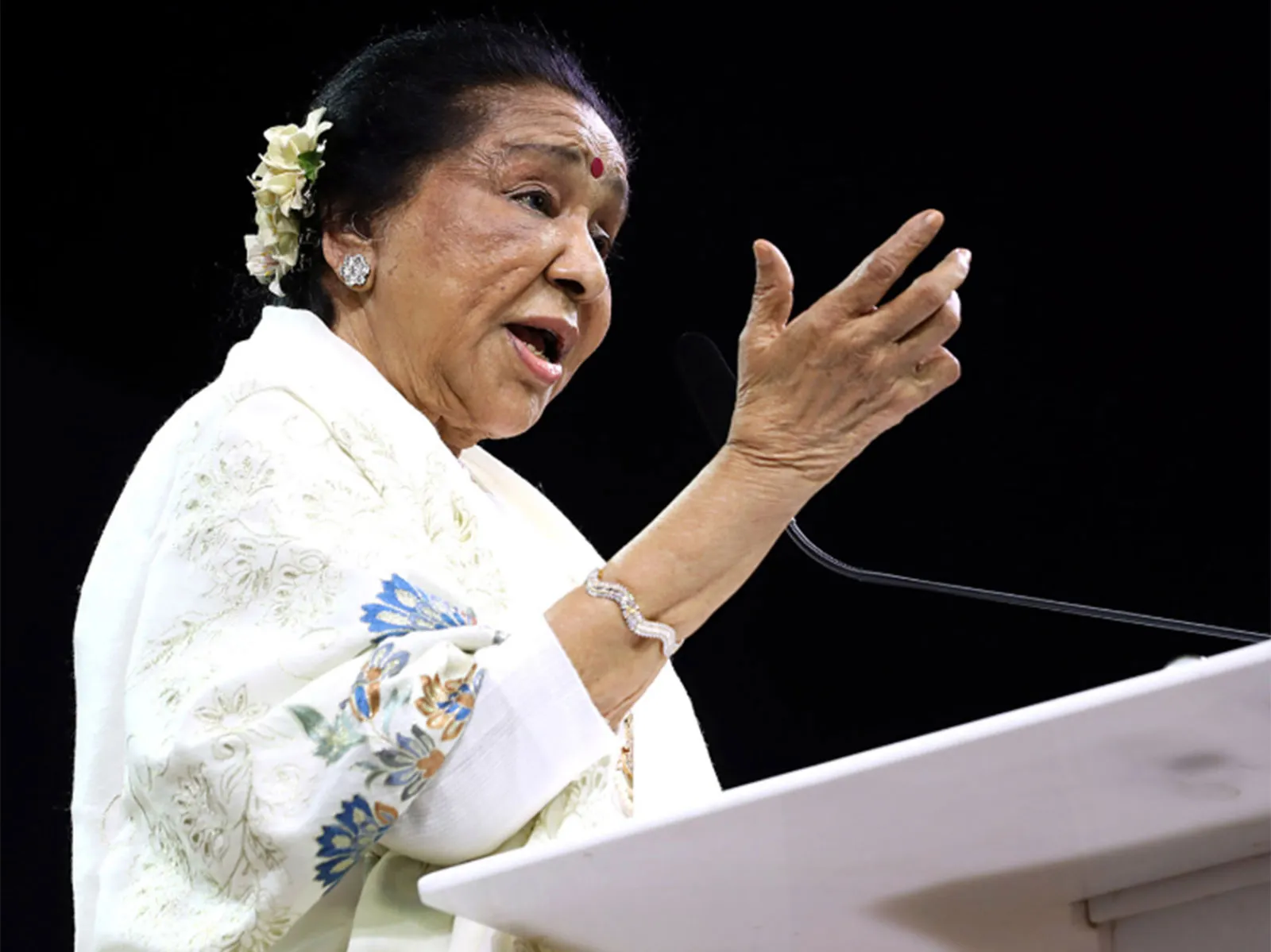
New Delhi, April 12: With the passing of Asha Bhosle at the age of 92, the world of music has lost not merely a singer but an era, a soundscape, and a living archive of emotion.
Her voice, at once playful and profound, sensuous and spiritual, echoed across generations, languages, and continents. She passed away on Sunday at Breach Candy Hospital due to multi-organ failure, bringing to a close a life that had, for over eight decades, defined the very soul of Indian music.
To attempt to summarize Asha Bhosle's legacy is to attempt the impossible. She was not just prolific, though her over thousands of recorded songs in multiple languages earned her a Guinness World Record as the most recorded artist in history, but also transformative.
She did not simply sing songs; she reshaped how songs could be sung, how emotions could be conveyed, and how a voice could transcend boundaries of genre, age, and expectation.
Born Asha Mangeshkar on September 8, 1933, in Sangli, she entered a household steeped in classical music. The daughter of the revered Pt Deenanath Mangeshkar and the younger sister of Lata Mangeshkar, her destiny seemed intertwined with melody from the very beginning.
Yet her journey was far from easy. The sudden death of her father when she was just nine years old made her and her sister step into the world of playback singing.
Asha Bhosle's breakthrough came in 1957 with 'Naya Daur', in collaboration with composer OP Nayyar. It was a turning point that revealed her unique tonal quality which was playful, expressive, and daring. Soon, she became the unmistakable voice behind some of Hindi cinema's most vivacious characters, especially for the iconic dancer Helen.
Songs like 'Piya Tu Ab To Aaja' and 'Yeh Mera Dil Yaar Ka Diwana' didn't just entertain; they redefined sensuality in Indian film music.
Yet, to reduce Asha Bhosle to cabaret numbers would be to miss the essence of her genius. She was, above all, an artist of astonishing versatility. When she lent her voice to the ghazals of 'Umrao Jaan' in 1981, she showed the world her classical depth.
'Dil Cheez Kya Hai' and 'In Aankhon Ki Masti' were not just songs; they were masterclasses in restraint and nuance. For this, she earned her first National Film Award, affirming her place among the greats of Indian classical and semi-classical music.
Her ability to evolve with time was perhaps her most remarkable trait. Decades into her career, she embraced change with the curiosity of a newcomer.
Her collaboration with AR Rahman in 'Rangeela' (1995), particularly in songs like 'Tanha Tanha,' stunned audiences, here was a voice in its sixties sounding fresher and contemporary just like the singers half her age. She even ventured beyond Indian music, collaborating with international artists and genres, proving that her artistry knew no borders.
Recognition followed her at every stage. She was awarded the Padma Vibhushan, India's second-highest civilian honor, in 2008.
The Dadasaheb Phalke Award, Indian cinema's most prestigious recognition, came in 2000. She won multiple Filmfare Awards and received international acclaim, including a historic Grammy nomination in 1997 for her album 'Legacy.'
Beyond the recording studio, Asha Bhosle was also a passionate cook, often saying in her interviews that had she not been a singer, she would have been a chef. This was no idle claim. She transformed her love for food into a thriving global restaurant chain, 'Asha's,' which brought her personal recipes to diners across Dubai, the UK, and the Middle East.
Speaking about her personal journey, she was married first to Ganpatrao Bhosle and later to the legendary composer RD Burman. She shared with the latter a partnership that was both creatively explosive and deeply affectionate. Their collaborations produced some of the most iconic songs in Indian cinema including, 'Dum Maro Dum', 'Mera Kuchh Samaan', 'Duniya Mein Logon Ko', 'Jaane Jaan Dhoondata Phir Raha', 'O Mere Sona Re Sona', and 'Do Lafzon Ki Hai Dil Ki Kahani', among many others.
Even after his passing in 1994, his influence remained intertwined with her music.
To understand Asha Bhosle is to listen, not casually, but attentively. From the seductive allure of 'Piya Tu Ab To Aaja,' to the aching elegance of 'Dil Cheez Kya Hai,' from the breezy romance of 'Chura Liya Hai Tumne,' to the youthful exuberance of 'Tanha Tanha,' her repertoire is a map of human emotion. Each song represents not just a moment in cinema, but a moment in the listener's life.
Her passing marks the end of an era, but her voice will never truly fall silent. It will live on, in vinyl records and streaming playlists, in nostalgic recollections and new discoveries, in kitchens and concert halls, in heartbreak and celebration.
She is survived by her son Anand Bhosle and several grandchildren.
On Sunday, Anand Bhosle confirmed the death of her mother and the details of her last rite. "People can pay their last respects to her at 11 am tomorrow at Casa Grande, Lower Parel, where she lived. Her last rites will be performed at 4 pm tomorrow at Shivaji Park," he told media.
Maharashtra Minister Ashish Shelar also mourned the demise of the melody queen and announced that she will be cremated with full state honours.
Speaking to the media, Shelar said the entire country and Maharashtra are mourning the end of an era, adding that Bhosle's contribution to music brought joy not only to India but also to audiences across the world.
"Today, the entire country and Maharashtra are mourning the end of an era. Her work and her music were a source of joy not only for India but for the entire world," he said.
In a heartfelt message on X, Prime Minister Modi expressed deep sorrow, calling Bhosle "one of the most iconic and versatile voices India has ever known."
He credited her extraordinary musical journey spanning decades for enriching India's cultural heritage and said her songs would continue to inspire generations.
"Her voice carried timeless brilliance," he wrote, adding that he would always cherish his personal interactions with the singer.
"Deeply saddened by the passing of Asha Bhosle Ji, one of the most iconic and versatile voices India has ever known. Her extraordinary musical journey, spanning decades, enriched our cultural heritage and touched countless hearts across the world. Be it her soulful melodies or vibrant compositions, her voice carried timeless brilliance. I'll always cherish the interactions I've had with her. My condolences to her family, admirers and music lovers. She will continue to inspire generations and her songs will forever echo in people's lives," PM Modi wrote.
For as long as there are songs to be sung and hearts to feel them, Asha Bhosle will remain timeless, irreplaceable, and eternal. (ANI)
.webp)