
.webp)


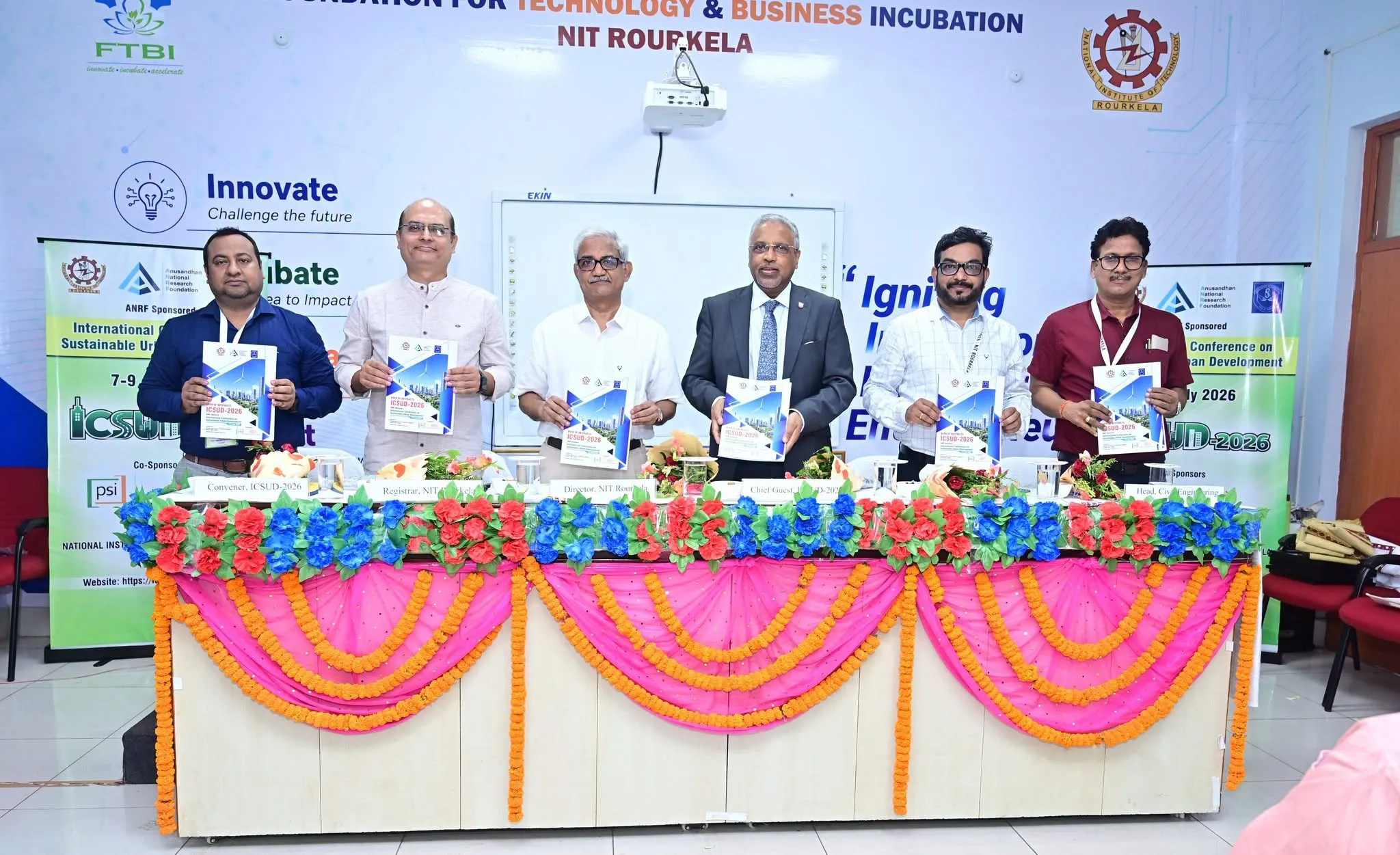
Rourkela, July 10: The National Institute of Technology (NIT) Rourkela organised International Conference on Sustainable Urban Development (ICSUD-2026) from July 7 to July 9. The three-day multidisciplinary conference, being held in hybrid mode, is jointly organised by the Departments of Civil Engineering, Humanities & Social Sciences, Earth & Atmospheric Sciences, and Planning & Architecture.
The inaugural session was graced by Prof. M. Satish Kumar, Dean, Queen's University Belfast (India Campus), Gandhinagar, as the chief guest. The programme was presided over by Prof. K. Umamaheshwar Rao, Director, NIT Rourkela. Among those present were Prof. Rohan Dhiman, Registrar; Prof. Kishanjit Kumar Khatua, Head of the Department of Civil Engineering; Prof. Jalandhar Pradhan, Chairperson of ICSUD-2026, along with faculty members, researchers, students, and delegates from India and abroad.
Welcoming the participants, Prof. Jalandhar Pradhan informed that the conference received over 350 research paper submissions, of which nearly 200 papers were selected for presentation. He noted that the conference features keynote lectures, plenary sessions, technical presentations, and thematic discussions focusing on practical and innovative solutions for sustainable and resilient urban development.
Addressing the gathering, Prof. K.K. Khatua, Head of the Department of Civil Engineering, emphasised that sustainable urban development demands an integrated approach encompassing engineering, urban planning, environmental sciences, governance, and public policy.
He observed that the conference provides a valuable platform for researchers, policymakers, and practitioners to deliberate on innovative strategies to address pressing challenges related to rapid urbanisation, climate change, infrastructure development, and resource management.
In his inaugural address, Prof. K. Umamaheshwar Rao, Director, NIT Rourkela, underscored the importance of collective responsibility, interdisciplinary collaboration, and sustained commitment in advancing sustainable urban development. He appreciated the collaborative efforts of the four academic departments in organising the conference.
He said, "Sustainability is not merely about infrastructure or technology; it is about commitment, accountability, and responsible action. Every decision we make today in planning and development will shape the quality of life for future generations. Conferences like ICSUD-2026 provide a platform to develop practical, interdisciplinary solutions for creating resilient and sustainable cities."
Delivering the keynote address, Prof. M. Satish Kumar highlighted the significance of integrating indigenous knowledge systems with modern scientific approaches to achieve sustainable development. He highlighted that India is uniquely positioned to provide moral leadership in achieving a sustainable future for humanity.
He remarked, "The ideas of sustainability are deeply embedded in our traditional knowledge systems. Modern innovation becomes truly impactful when engineering, social sciences, environmental studies, and public policy work together to address societal challenges."
The conference has brought together researchers, academicians, policymakers, urban planners, industry professionals, and students from India and abroad to exchange ideas on emerging research, innovative technologies, and policy interventions aimed at fostering inclusive, resilient, and sustainable urban environments. Through its multidisciplinary deliberations, ICSUD-2026 seeks to strengthen collaborations and generate actionable solutions to address the complex challenges of contemporary urban development.
.webp)