


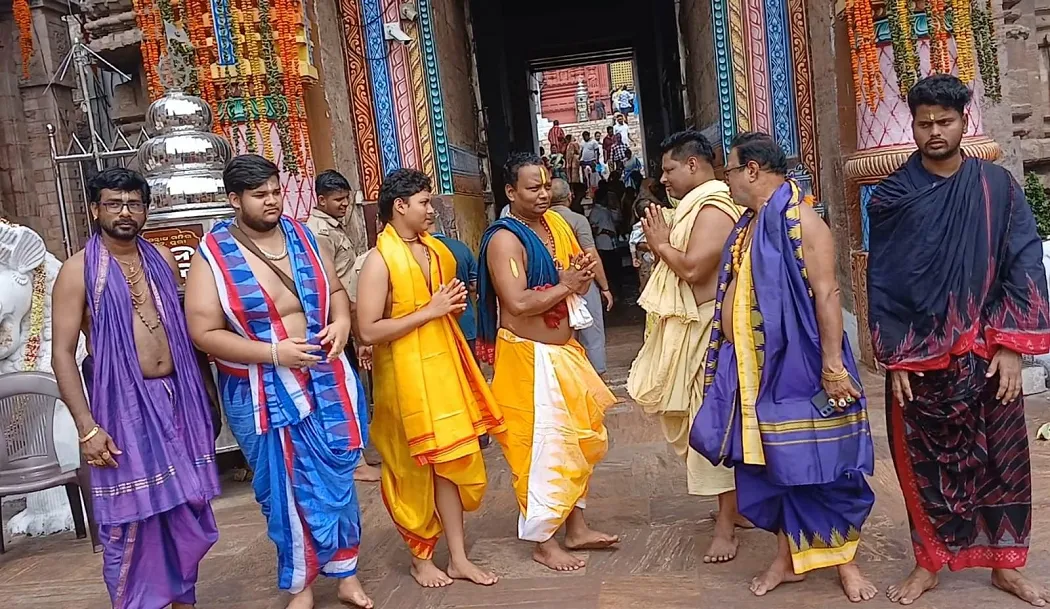
Puri, June 27: The Daitapati servitors entered the Shree Jagannath Temple in Puri on Saturday on the auspicious occasion of Jyestha Shukla Trayodashi, marking the beginning of their month-long responsibility for the rituals, care and protection of Lord Jagannath and His siblings ahead of the Snana Yatra and the world-famous Rath Yatra.
From today, the Daitapatis will remain in charge of the deities' sacred rituals and the protection of the holy idols. Following the Sandhya Dhupa ritual on Saturday evening, they will perform the Bahuta Kanta Niti, while the Kotha Suansias will tie the Charamala. On Sunday, the deities will be covered with traditional Patabastra before the Senapata Lagi ritual.
With the Snana Yatra just around the corner, a festive atmosphere has gripped Puri as devotees from across the country continue to arrive for darshan of the deities on the Snana Bedi. Sevayats, researchers and devotees are eagerly waiting to witness the unique rituals associated with Lord Jagannath's human-like divine pastimes.
The Daitapati servitors hold a unique and significant position in the Jagannath tradition. They are regarded as the Lord's closest relatives and are entrusted with several secret and sacred rituals that no other servitors can perform. During the Nabakalebara ceremony, they play the central role in carving the sacred wooden idols and conducting the rituals associated with the transfer of the divine essence from the old idols to the new ones.
The Daitapatis also observe mourning rituals after the burial of the old idols during Nabakalebara, reflecting their deep spiritual and familial bond with Lord Jagannath. As part of the tradition, they perform purification rituals, take a ceremonial bath at Markandeya Tank and offer sesame oblations in honour of the deities.
Their service is based on hereditary tradition and is carried out collectively by members of Daita families. Every male member of a Daita household is entitled to participate in the service. A newborn male child is formally inducted into the tradition 21 days after birth by being taken into the temple and presented before Lord Jagannath. He then becomes eligible to inherit the family's service rights.

Unlike many other temple services, Daita Seva does not require formal training or initiation. Younger members learn the rituals by assisting and observing senior family members over the years. At present, more than 150 Daitapati servitors, irrespective of age, are associated with this hereditary service.
The Daitapatis perform their duties in three traditional groups, each headed by a senior leader known as the Badagrahi. Although divided into separate groups, they work together in close coordination to complete all rituals smoothly during the month-long period leading up to and including the Rath Yatra.
As part of their traditional rights, the Daitapati community receives a share of the temple's annual revenue and is also entitled to special rewards for successfully performing their additional responsibilities during the Rath Yatra.