
.webp)
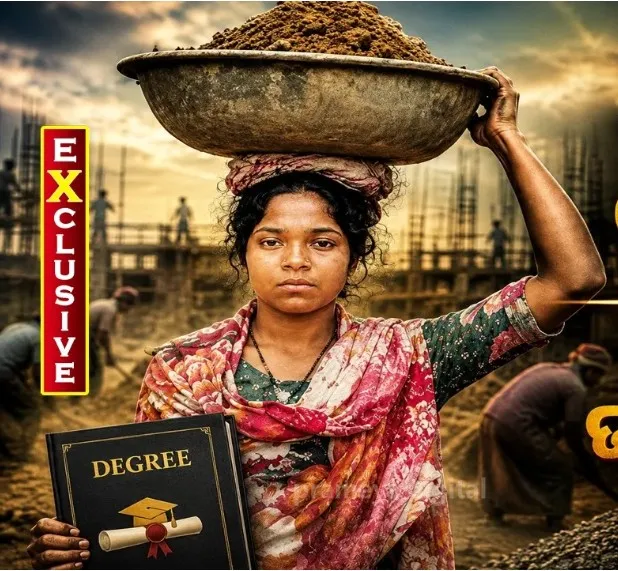
Koraput, August 4: A diploma certificate lies safely at home, but every morning Sukanti Paraja walks to a construction site carrying something far heavier than her academic achievement. On her head rest baskets of cement, sand and stones; in her heart survives a dream that refuses to die.
Hailing from Mundaguda village under Mahadeiput Panchayat in Odisha's Koraput district, Sukanti once believed education would become her pathway out of poverty. Bright in studies from an early age, she battled financial hardship with determination, passed her matriculation examination, and enrolled in a diploma course at a local engineering college. Like thousands of young students from remote tribal regions, she saw education as the key to a better future.
But fate intervened before that dream could take shape.
While she was still pursuing her studies, tragedy struck. Both her parents passed away, leaving her without emotional or financial support. The loss changed the course of her life overnight. With no one to support her education, her aspirations of studying further came to an abrupt end.
Even after completing her diploma, Sukanti did not give up. She applied for jobs in government departments and private companies, attended interviews, and waited for opportunities that never arrived. Each rejection pushed her closer to a painful reality.
Eventually, survival took precedence over ambition.
Today, the diploma holder spends her days carrying bricks, gravel, sand and cement at construction sites across Koraput town. Under the blazing sun and through pouring rain, she works alongside other daily wage labourers, earning enough to keep hunger at bay. The certificate that once symbolized hope now remains overshadowed by the weight of manual labour.
Yet Sukanti refuses to see dignity in work through the lens of status. "No work is small or big," she says. "Hard work helps us earn our daily bread." Despite her circumstances, she continues to believe that one day her education will find its rightful value.
Her struggle is not an isolated story.
According to Sukanti, many educated tribal youth in Koraput are facing a similar predicament. Despite acquiring qualifications, they are unable to secure jobs that match their education or skills. With few employment opportunities available in the region, many have little choice but to take up daily wage work to support themselves and their families.
Her story reflects a larger challenge confronting tribal districts like Koraput. While governments have expanded access to education through scholarships, hostels and welfare schemes, employment opportunities have not kept pace. For many graduates, the journey from classroom to career ends not in an office but at a construction site.
Local intellectuals argue that the district urgently needs targeted employment initiatives, including special recruitment drives for educated tribal youth, industry partnerships, skill-development programmes and stronger connections with the private sector. Without such interventions, they warn, education alone cannot break the cycle of poverty.
Life, meanwhile, has moved on for Sukanti. She is now married to Khaga Muduli of Dangari village under Mastiput Panchayat, who also earns a living as a daily wage labourer. Together, they continue to work in the hope that a better opportunity may one day arrive.
Sukanti's story is more than a tale of personal resilience. It raises a difficult question about the promise of education in India's underserved regions. When a qualified young woman with a diploma is compelled to carry cement instead of building a career, it is not merely an individual setback—it is a reminder that education without employment leaves many dreams unfinished.
.webp)