



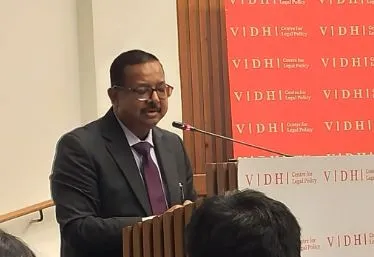
New Delhi, Aug. 1: Supreme Court judge Justice Ujjal Bhuyan on Saturday called for greater transparency in the Supreme Court Collegium's process of appointing and transferring judges, saying citizens have the right to know how judges are selected and who will serve on the bench.
Speaking at the launch of the Judicial Transparency Index, prepared by the Justice, Access and Lowering Delays in India (JALDI) Initiative at the Vidhi Centre for Legal Policy, Justice Bhuyan said the Collegium system continues to function with a high degree of confidentiality, limiting public access to key decisions.
He noted that deliberations on the elevation and transfer of judges remain confidential, while reasons for rejecting or deferring recommendations are rarely disclosed in full. He also pointed out that the criteria used by the Collegium are not codified in any publicly available document.
Justice Bhuyan urged future editions of the Judicial Transparency Index to evaluate the opacity of the Collegium system, stressing that judicial appointments should be subjected to the same standards of transparency as judicial functioning.
"Citizens have a right to know what is happening in the courts. They have a right to know who would be their judges. They have a right to know judgments. These should be in the public domain," he said.
The judge also expressed concern over a recent shift in the Collegium's practice of publishing appointment resolutions. He observed that the last three Collegium statements recommending appointments to constitutional courts did not provide any reasons for the recommendations, unlike earlier resolutions that at least offered brief explanations.
"It is going back on the transparency principle," Justice Bhuyan remarked, adding that while earlier reasons were sometimes criticised as repetitive, the complete absence of reasons marked a setback for openness.
Referring to the Collegium's recommendation of Senior Advocate Saurabh Kirpal for appointment as a judge, Justice Bhuyan said he found the recorded reasons convincing but noted that despite more than three-and-a-half years having passed, the appointment has yet to materialise.
Highlighting the broader principle of open justice, Justice Bhuyan said every legal system must answer the question of accountability. Drawing on the works of philosophers Plato, Hegel and Jeremy Bentham, he said public scrutiny is fundamental to the administration of justice and not merely an aspect of good governance.
He added that the principle of open justice is firmly embedded in Indian constitutional and statutory law, with court proceedings generally required to be held in public except under limited circumstances.
Welcoming the Judicial Transparency Index as an important initiative, Justice Bhuyan acknowledged that the Indian judiciary has made significant progress in improving transparency but said much more needs to be done to institutionalise openness across the judicial system.
The Judicial Transparency Index is the first comprehensive study assessing transparency practices across the Supreme Court and High Courts. It evaluates disclosure of information relating to judicial processes, institutional governance, administration, and judicial and administrative personnel.
Justice Bhuyan also congratulated JALDI and the Vidhi Centre for Legal Policy, along with their teams led by Jyotika Randhawa and Aarogya Sen Gupta, for producing what he described as a valuable resource to strengthen transparency within the judiciary.