
.webp)


Visualizing memory and time through deeply textured abstract canvas creations.
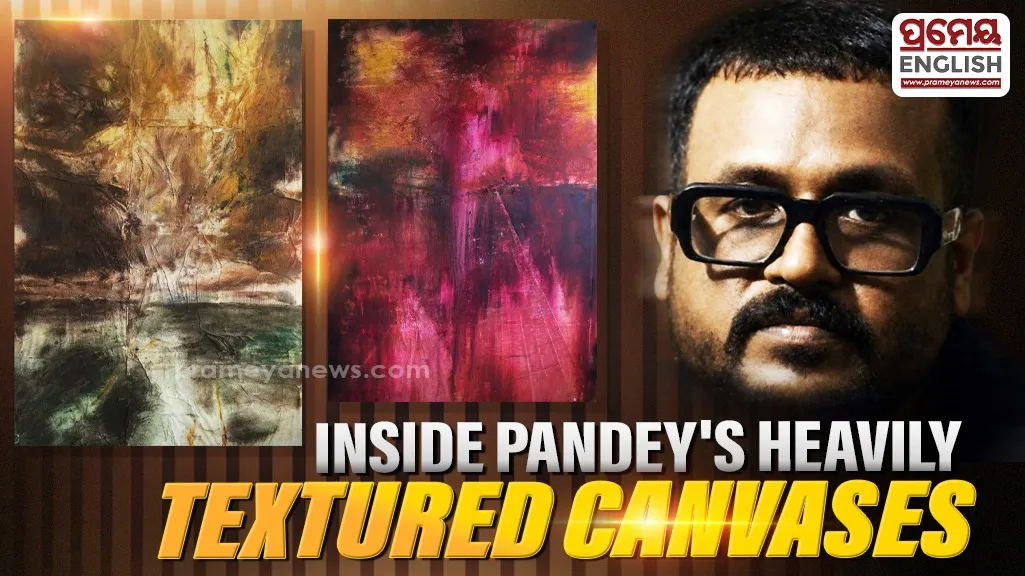
Painter Anup Pandey translates shifting landscapes and personal recollections into heavily textured visual experiences. His ongoing series, "The Horizon Still Breathing — Vol. 1," relies on a robust high-impasto method. By applying pressure with a spatula, he builds overlapping layers that document physical effort and suggest the passage of time, rather than presenting a literal depiction of a dense forest or shoreline. Deliberate water marks and dripping paint run freely across the canvas, demonstrating a preference for raw authenticity over polished perfection. While embracing these spontaneous elements, he selectively softens certain areas to maintain visual hierarchy and compositional balance.
In the broader context of contemporary Indian abstract art, integrating localized earth elements provides a unique grounding to conceptual pieces. Pandey sources his distinct visual vocabulary directly from his hometown of Tata. Observing the dusty, weathered walls of nearby villages, he incorporates organic pigments to mirror those earthy environments faithfully. Ochre, deep browns from iron-rich soil, red clay, and black charcoal dust dominate his specific palette. These natural binders ensure the canvas stops functioning merely as a passive backdrop. It transforms instead into an active, tactile entity carrying traces of dust, friction, and environmental wear over extended periods.
Also read: Ramayana creates history! Ranbir Kapoor’s ₹1,600-Cr epic releases Worldwide
Crafting tactile canvas environments
Viewers encountering these abstract creations often feel a strong instinct to reach out and touch the artwork. The deep ridges and layered paint bridge the gap between simple visual observation and physical interaction. Rather than enforcing a strict narrative viewpoint, the merging, fluid forms encourage audiences to find their own meaning within the breathing spaces. The depicted horizon operates primarily as an ongoing transition zone between distinct emotional states.
Expanding into three-dimensional orms
Looking beyond traditional flat surfaces, the creator plans to transition his material focus directly toward sculpture. Translating these fluid, earthly sensations into physical spatial encounters represents his next major creative phase. Reimagining familiar sensory details in an entirely different medium allows his initial rural memories to continually evolve and grow. Each completed canvas or future sculpture serves not as a static conclusion, but as an open space for continuing viewer interpretation.
.webp)